
(What’s on at Watts’)
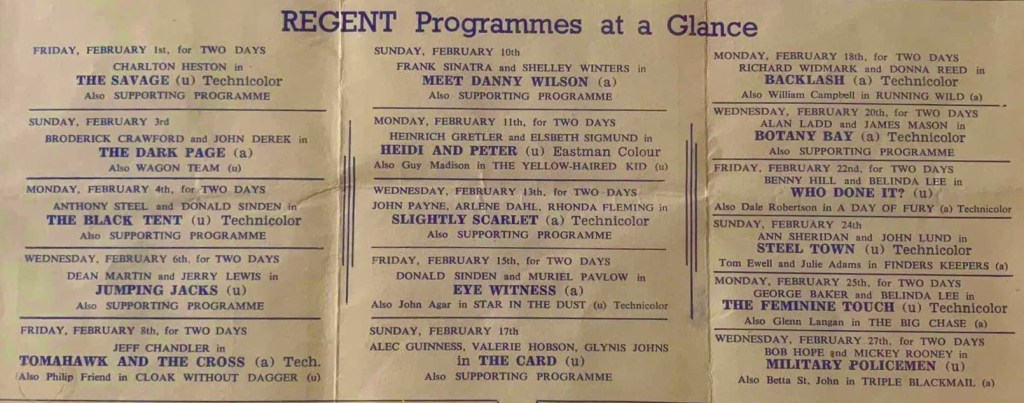
~
The building that was to eventually become the Regent Cinema (originally named The Regent Palace Cinema) situated unsurprisingly along Regent Street in Finedon, began its life in 1822 as the town’s first Methodist Chapel, preceding the inauguration of a new Chapel building in 1904, which was to be located at the junction of Summerlee Road and Wellingborough Road.
It became the Regent Palace Cinema in 1926; Alfred Watts was the proprietor, who had previously run the ‘Star Cinema’ in the nearby Star Hall situated on Laws Lane, that itself had been initially established by George Robinson in 1920. The original Star Hall which had opened on 29th April 1898 began life as a Men’s Temperance Institute, offering tea and dancing. Initially, the cinema was only allowed to open on certain nights of the week.
The Star Cinema was taken over from Richard George Robinson in 1923 by the Irthlingborough Theatre Syndicate, Alfred Watts was one of the three partners in the syndicate, the other two being Alvah Allibone Drage and Fred Line. This was in the early part of 1923. Later that year in June 1923, The Electric Palace in Burton Latimer was experiencing financial difficulties and facing Bankruptcy, so Alfred Watts stepped in and took over the running of it. In 1925, Alfred Watts bought out A A Drage and F Line, thus disbanding the syndicate. It is thought that the Star Cinema closed in March 1926 and the Regent Palace opened on 25th October 1926. In 1929, Alfred made his son Geoffrey manager of the Electric Palace.
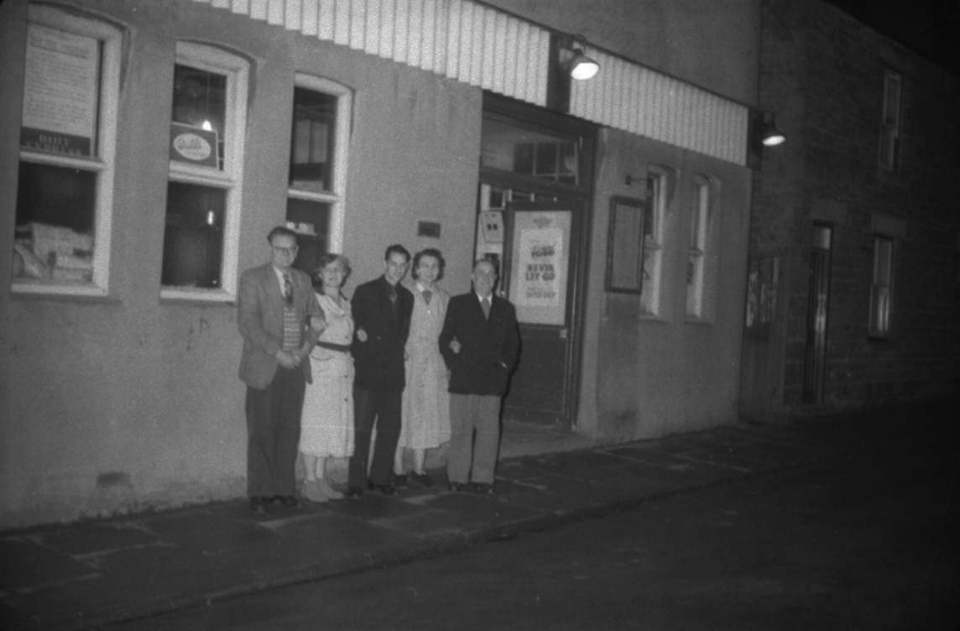
Upon Alfred Watts’s death in 1938 his son Geoffrey Watts took over the whole cinema business (including The Regent), with his sisters Marjorie and Doris taking an active part, each becoming managers of their respective cinemas locally. The Watts family owned all three cinemas, in Finedon (The Regent) in Burton Latimer (The Electric Palace) and Irthlingborough (The Picture Palace). Irthlingborough had the largest capacity with 490 seats, with Burton Latimer 450 and Finedon with only 300 seats being the smallest. The slogan that quickly became synonymous with the Regent was “What’s on at Watts’ Cinema”. Grandson Tom Watts can remember that in those early days, in the 1950s, the company owned a dark blue Ford Popular van with that slogan sign-written on the side as advertising.
Conveniently, and more so economically, films would be shown at all three cinemas during a weekly rotating schedule.The programme screened in Finedon on Monday and Tuesday evenings, would then go to Burton Latimer for Wednesday and Thursday and finally end the week at Irthlingborough for Friday and Saturday. In this way the local audiences enjoyed a varied programme each and every week and would have been able to travel to neighbouring cinemas if more socially convenient and in order not to miss anything. The Finedon Regent also enjoyed an extra showing as it was the only one in the group that was allowed to show films on a Sunday.
When the Regent Cinema first opened the prices of admission were 3d, 6d, 9d, 1/- and 1/3d. Children were admitted for half price when accompanied by an adult. The seats in the first three rows at the front were quite basic wooden forms, whereas the 1/- seats were green leather and the 1/3d an altogether plusher red leather. Tickets for these uncomfortable wooden seats were 3d in old money (the equivalent of less than 2p today). However, a typical, much-worked ploy, often used if children could not afford to pay, would be to club together what little money they had within a group of their friends, sending two people into the cinema, who paid, who would then open a back door by the toilets to let the rest of the gang in for free!
What was not realised at that time by the public and more importantly the children, was that there was an “Entertainment Tax” on each ticket sold and if caught by the Inland Revenue the penalty would a fine of £5.00 for the customer and a fine of £50.00 for the cinema proprietor who had allowed them to enter without paying. This tax was initially only a temporary tax, first levied in 1916 to help with the WW1 war effort. Unfortunately, it lasted until 1960 and was one of the prime factors responsible for the eventual decline of the cinema industry.
Geoffrey Watts’s son Tom, recalls the sad demise of the Regent Cinema on the last night’s showing in December 1960. He remembers,
‘I was at Finedon in the projection room at the end, shutting down the arc-lamp and turning off the projector for the very last time, then removing the film from the projector and putting it in the can’.
‘I remember taking it down to the Foyer and waiting there for my Father to come from the Burton Latimer Cinema with that film. Marjorie, my Aunt, then brought the film from Irthlingborough and we all waited for the Film Transport vehicle to arrive, which we had done every Saturday night for as long as I could remember. We loaded the films on the lorry but this time there were no new films to unload for the following week. This was truly THE END of an era’.
In a subtle twist of fate, some of the redundant seats from The Regent Cinema actually found their way back for use in the Star Hall, the cinema’s first home of course, and saw many year’s use for the town’s famous Pantomime and other Am-Dram productions.
There are many wonderful memories of The Regent. One such recollection is from Janet Schmelzer, an émigré to the USA, who remembers seeing future President Ronald Reagan on the silver screen in Finedon. She also recalls one of her schoolfriends’ grandmother, a Mrs Pugh working there, often needing to quieten the children down when the film projector broke down as they shouted and stomped ‘put a shilling in the meter’. Occasionally, she was also required to dash down to open the curtains, which had failed to open as the film was beginning, to similar chants of jocular abuse.
Another local cinema-goer, Martin Bailey, recalls the only time that he saw a long queue to enter The Regent was at the showing of ‘Rock around the Clock’ with Bill Hayley in 1958 and fondly remembers his favourite KP peanuts were only 2d a bag (that’s old money for our younger readers). Another local David Henderson remembers from the late 1950s, early 1960s, a member of staff named Warner who collected tickets and was the doorman and security guard who ‘scared the living daylights out of us cherubs’ back in the day.
John Hibbert’s uncle, Reg Richardson, was the projectionist at The Regent. Owners son Tom Watts remembers that about a year before the closure of the Regent, Reg went on to work for a company named GB Kalee which both supplied and maintained cinema equipment nationally. There is a wonderful anecdote to this recounted here by Tom.
‘Reg left the Regent some time before it closed, maybe a year or so, he went to do some training in London, with Kalee, and told me how he had gone to Buckingham Palace to maintain the equipment in a private cinema for the Royal Family. This cinema was a gift to Princess Elizabeth and the Duke of Edinburgh from the British Film Industry for their wedding in 1947’.
Sadly, Tom Watts (who aims to write a book about the three Watts’s cinemas) remembers that only at the eleventh hour before closure did anyone in the family think of recording photographically the three venues. Tom therefore had to make a swift dash around with his camera and snap a few pictures before the final curtain and the doors were bolted. Only with the benefit of hindsight did he realise that there were many more he could have taken.

 From Tingdene to Finedon