
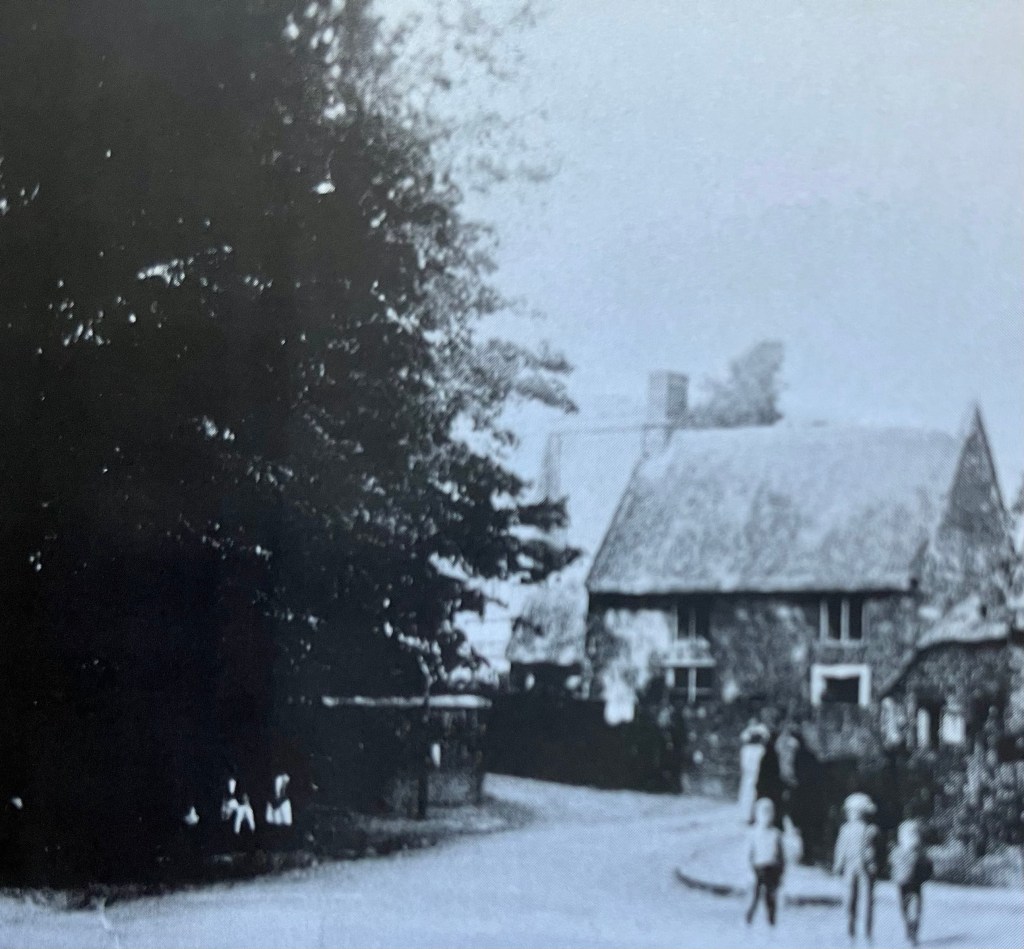
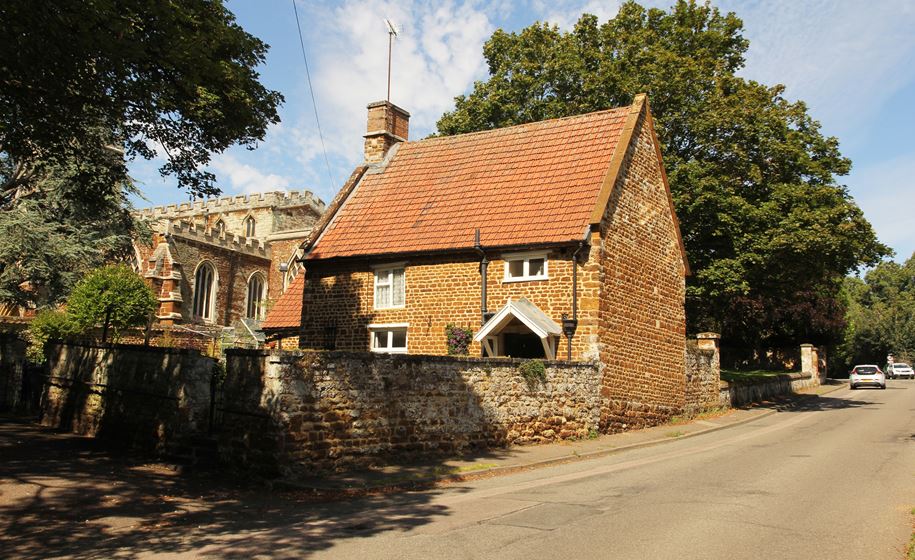
Known locally as the ‘Old Maid’s Cottage, Hampton Cell stands at the bottom of the St Mary’s Churchyard at the base of Church Hill. The cottage owes its existence to a Miss Deborah Hampton who, until her death in 1725, was housekeeper to Lady Anne Dolben, the widow of Sir Gilbert Dolben.
~
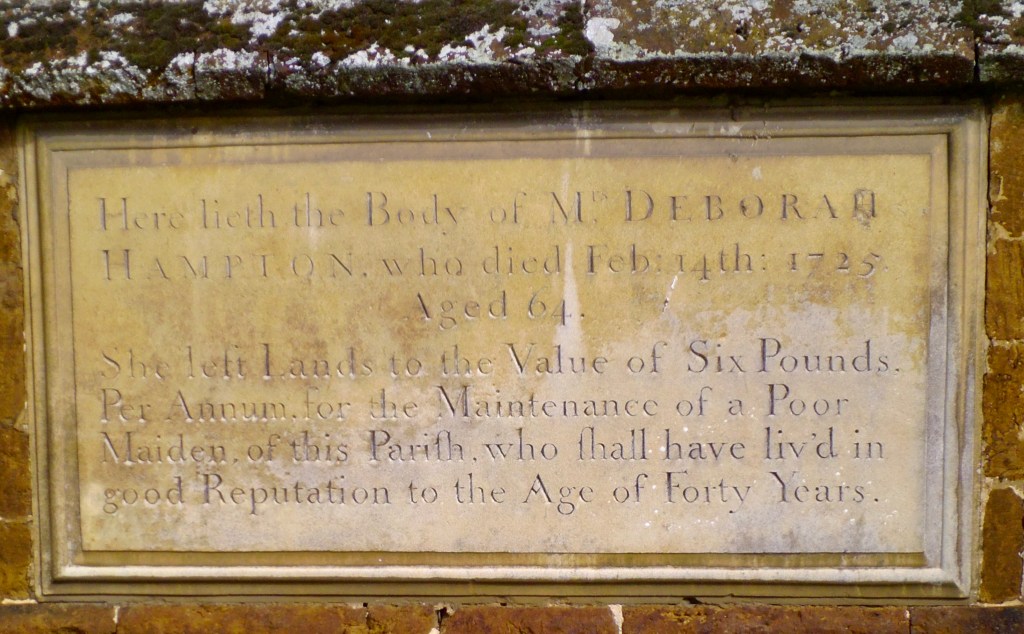
In her last will and testament, Miss Hampton decreed that the land that she owned (a sixteen-acre field on the north side of Thrapston Road) be held in a trust for her two sisters and a niece, then after their demise, that the rents from the land be used to maintain a ‘one poore maiden of the parish of Finedon who has lived to the age of fourty years in modest report’.
~
She also subsequently further decreed that three years rent from the land be used to build a ‘small tenement for the poore maiden to dwell in’ and the provision of two shillings every week for her support. The trustees of this arrangement were Sir John Dolben, the incumbent vicar of the time and Mr John Walton the schoolmaster.
In his book, ‘Finedon Otherwise Thingdon’, (from where these details are respectfully reproduced) local historian John L H Bailey states that whilst there is a 1742 date stone carved in a stone lintel above the door of the cottage, the building must pre-date this as rates were being paid on it in 1738.
The earliest recorded occupant of Hampton Cell is Elizabeth Sibley who lived there in 1806, she died in 1838, aged 76 and was succeeded by Hannah Wallis who died in 1848, aged 80. The next incumbent was Mary Freeman, who in 1851 had an old pauper, Martha Wallis, lodging with her. Miss Freeman died in 1866 aged 65 and was succeeded by Mary Tompkins who was there in 1871, although Reginald Underwood, in his book Pageant of Finedon, suggests that her sister Hannah Tompkins may have preceded her for a short time before leaving to marry a local wart charmer!
~
Mary Tompkins (known locally as Mary Maid) remined at Hampton Cell until 1906 when she died at the age of 90. Ann Newman Willis became the next occupant until she died in 1912, being succeeded by Louisa Vincent and after her death Miss Ada Young became the “Old Maid” in 1918 remaining there until 1949 when she was admitted to a local hospital. Following this, the property was declared unfit for human habitation and there had been a potential risk that it may have been demolished.
The Charity Commissioners supported a loan for its renovation and in 1951 Miss Adeline Chapman became the next occupant until she died in 1953, succeeded by Miss Mabel Ager until she left the cottage in 1965. As no properly qualified applicant could be found Hampton Cell was let to a married woman Mrs Mildred Brown in 1965 who remained for a few years and then left which gave the opportunity for Miss Lillian Chapman to move in 1968 and remained there until her death. Miss Molly Thompson in 2003 became the next ‘old maid’ before making way for the present incumbent Ms Enid Biggs in 2017.
Elizabeth Sibley, 1806-1838
Hannah Wallis, 1838-1848
Mary Freeman, 1851-1866
Hannah Tompkins, 1866-1871
Mary Tompkins, 1871-1906
Ann Newman Willis, 1906-1912
Louisa Vincent, 1912-1918
Ada Young, 1918-1949
(closed for renovation)
Adeline Chapman, 1951-1953
Mabel Ager, 1953-1965
Mildred Brown 1965
Lillian Chapman 1968-2001
Mollie Thompson, 2003-2017
Enid Biggs, 2017-present
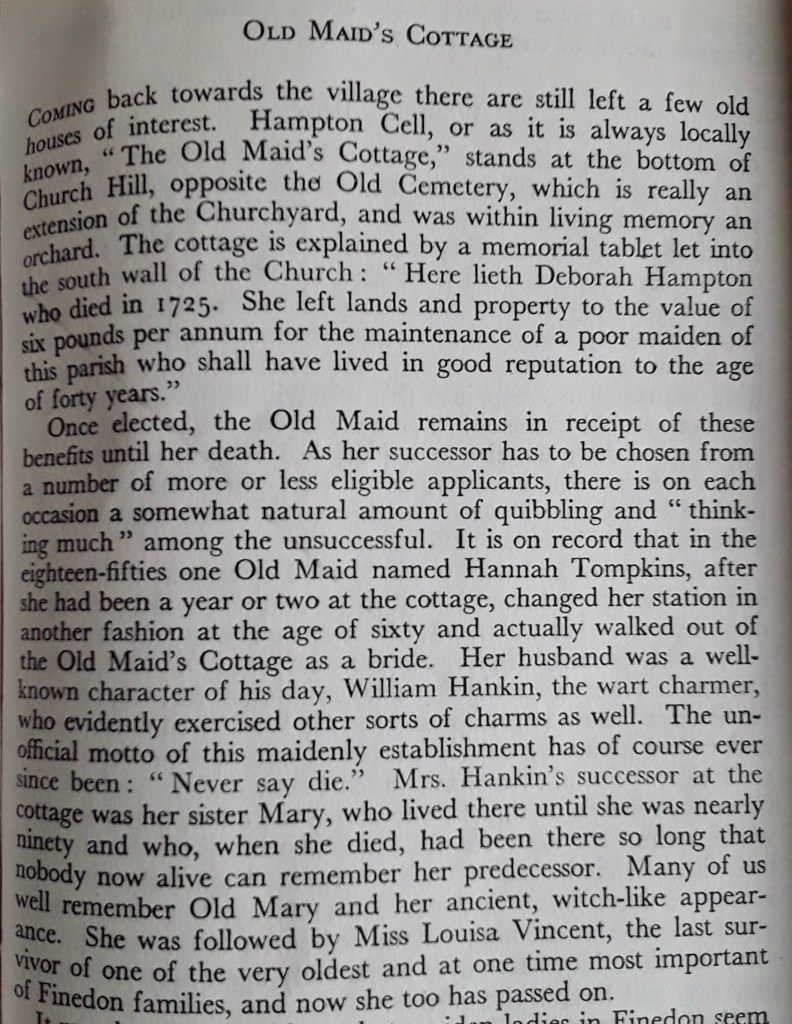
An excerpt from Reginald Underwood’s ‘A Pageant of Finedon’.
~
Hampton Cell is a grade II listed building by Historic England in 1970
Listed as a Bed House. Alms-house. Datestone 1742. Regular coursed ironstone with pantile roof 2-unit plan. 2 storeys. 2-window range of C19th and C20th casements under wood lintels. Cl9th door to right under stone lintel has gabled hood. Ashlar gable parapet and stone stack at end. Inscription over door “Hampton Cell Anno Dom 1742”. Single storey outhouses attached to left. Endowed as an alms-house by Miss Deborah Hampton. (Finedon Otherwise Thingden by J.L.H. Bailey, p.122).
 From Tingdene to Finedon