
~
History and Ownership
From the early 15th to the 18th century, the manor of Finedon was in the hands of the Mulso family. Upon the death of Tanfield Mulso the last of the Mulso line, Finedon passed to his daughter, Anne, who married Sir Gilbert Dolben, 1st Baronet. The house remained in the Dolben family until the death of the last baronet, Sir John English Dolben, in 1837. It then passed down to his daughter, Frances, who married William Harcourt Isham Mackworth (1806–1872), a younger son of Sir Digby Mackworth, 3rd Baronet, who also took the name of Dolben. Sadly, both his heirs were drowned; the elder son William Digby Mackworth Dolben died whilst serving in the Royal Navy off the coast of Africa in 1863 and the younger, the noted poet Digby Mackworth Dolben, died aged just seventeen in 1867 whilst swimming in the River Welland, near South Luffenham in Rutland. The estate subsequently passed to their sister, Ellen, after whose death in 1912 the estate was divided and sold.
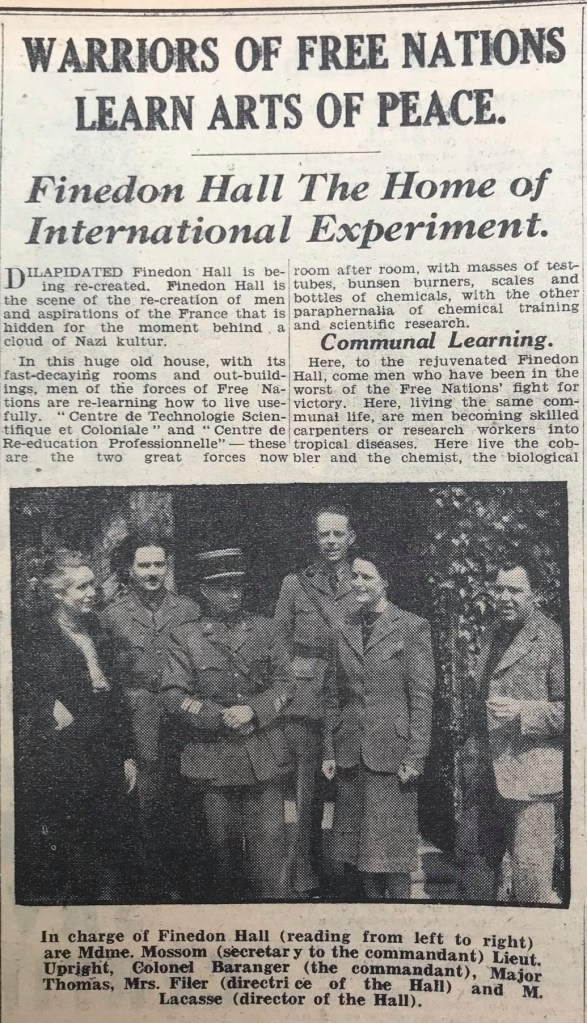
It is well recorded that in 1936 the hall was used by the Free French as a rehabilitation centre for allied troops, and was visited on at least one occasion by President Charles de Gaulle. This centre was run by Colonel Pierre Mallinger, who subsequently bought the hall and used it for some time as a centre to conduct research into tropical diseases. Following Colonel Mallinger’s death in 1971, the hall was sold to one Geoffrey St Clair Wade who had a scheme for developing it. Sadly, his proposal was never realised and by the time of his death, the condition of the house had fallen into a parlous state.
The hall would eventually be saved, in part, due to the efforts of the Ancient Monuments Society and during the 1990’s converted by developers into today’s current apartments.
The Building
The core of the house is 17th or 18th century, and was extensively remodelled by William Harcourt Isham Mackworth Dolben (1806–1872). There are datestones which indicate a range of different building phases: 1851, 1855, 1856 and 1859. The architect is unknown, but it is most likely to have been E. F. Law of Northampton although Mackworth Dolben was an ‘enthusiastic’ amateur architect himself.
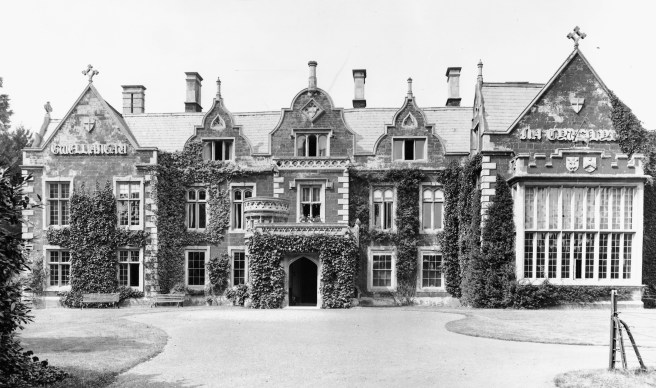
There is also a range of fine ancillary buildings: the Museum Tower, the Bell Tower and the Old Chapel, also listed Grade II. The estate was originally landscaped with advice from the renowned Humphry Repton. The Hall does have a listing by Historic England and is recorded as follows:
A Country house. Probably C17 and C18, datestones 18S5, 1851, 1856 and l859 record existing alterations, probably by E.F. Law, for William Mackworth-Dolben. Ironstone ashlar with limestone dressings and slate roof. H-plan, Tudor-Gothic style. Entrance front is 2 storeys with attic. Centre of five-window range with flanking gables breaking forward. Central porch has panelled door with four-centred moulded stone head with decorated and inscribed spandrels. Circular turret attached to left of porch forms part of ten-light stone-mullion window with transoms havinq moulded stone panels and a quatrefoil parapet above. Ground and first floor windows have C18 plain stone architraves with keyblocks and those at first floor have C19 four-light stone-mullion windows with transoms, inserted into the earlier surround. Centre bay breaks forward with quatrefoil parapet at eaves level and gargoyles at corners, three attic windows have Tudor style gables with three-light stone-mullion windows with shields and trefoil above. Projecting gable to left: has two-window range similar to centre range.

A projecting gable to right has large C19 twenty-two-light, square stone-mullion bay window. Return wall to left is similar, of one-window range. Rusticated ashlar quoins to all corners and plain castellated parapets with ashlar copings. Ashlar stacks at ridge and end. Inscription to left gable “Gwell Angau”; continuation in right gable “Na Vywilydd” is missing. Various heraldic shields.
Garden front to left of entrance front of seven-window range. Door openings to left and right of centre have moulded stone surrounds, that to left has segmental pediment. two-storey canted stone bay windows to centre and left of range have quatrefoil parapets. Similar single-storey square stone bay to far left. Windows have stone mullions some with transoms and C18 plain stone architraves. Two and three-light attic windows set in Tudor style gables, some now missing. Remains of various inscriptions and carved heads. Elevation to right of main front is plain in similar style with attached wall and ashlar gatepier.
Rear elevation has projecting gable to left and twin gables to right. Centre three-window range, one blocked, with C18 plain stone surrounds with keyblocks, Gable to right has tall, six-light stone-mullion staircase window with transom. Forms part of a group of buildings including The Museum Tower, Bell Tower, Old Chapel and attached wall.

The following is an extract from a FLHS Newsletter dated Sept 2018:
This article has been written following information kindly received from society member Janet Schmelzer (nee Dunkley, formerly of Mulso Road) who now lives in New Berlin, in the state of New York. Janet came across a reference to Finedon Hall in a book written by James Lees-Milne entitled, “Ancestral Voices, 1942 – 43”, published in 1975.
James Lees-Milne was, from 1936, the secretary of the National Country Houses Committee of the National Trust. The National Trust had only recently, at this time, adopted the conservation of country houses as one of its purposes. Lees-Milne’s task was to help compile a list of the houses most worthy of preservation, approach the owners and visit such of them as were potentially interested in arrangements with the National Trust.
At the start of the Second World War his work came to an end. In the spring of 1940, Lees-Milne was commissioned into the Irish Guards only to be seriously injured in a bomb blast during the London Blitz in October of the same year. Following 12 months of hospital treatment he was discharged from the army and took up his previous role with the National Trust.
Following the death of Miss Ellen Mackworth-Dolben in 1912 Finedon Hall passed through several owners who did nothing or very little to maintain the property. At one point it found its way into the ownership of the Bishop of Portsmouth “for the benefit of a diocesan scheme”. Some renovation work did commence with the intention of using the Hall as a rest home for retired clergy – this was never finished. Then, in 1936, Finedon Hall was sold to Major Greaves of Thingdon Cottage (brother of the Rev. Greaves, Vicar of Finedon, 1911 – 1928). Major Greaves kept the Hall empty until it was used by the Free French army during the war.
From 1942 to 1945, Lees-Milne describes and documents, in detail, in his famous wartime diaries (published in four books from 1975 onwards) his visits to country houses during those challenging and difficult days of wartime.
An extract from Lees-Milne’s diary entry for Finedon Hall, taken from Ancestral Voices, 1942 – 43 reads: –
Tuesday, 6th January 1942
…(I) motored with the sun in my eyes straight to Finedon Hall. The windscreen was so splashed with thawing slush that I could barely see. At intervals I was obliged to stop and wipe the glass with a rag and spit.
Major Greaves lives alone in the cottage (Thingdon Cottage) which he thinks wonderfully antique. It was built in 1850. He would not get down to business – with me – despite my prompting. Finally, I persuaded him to show me round the big house. It is interesting in being the childhood home of Digby Dolben, the poet school- friend of Robert Bridges.
The colour of the ironstone of which Finedon Hall is built the most beautiful imaginable, being deep orange, sprinkled with a powdery grey film of lichen. The Hall, once Elizabethan, was dreadfully altered about 1850 and is not suitable for the Trust. It is unfurnished and at present houses Free French troops. They were most offhand and rude to the poor Major, who I could see was a great tribulation to them, constantly prowling around and extolling his own property. In the dining room was a central stove, gothicky, and of the period…The grounds sad, the elm avenue disordered. The place neglected and pitiable…I was not sorry to leave.The opportunity for Finedon Hall to become a National Trust visitor attraction on the tourist route close to 80 years later has passed us by!

 From Tingdene to Finedon