
~
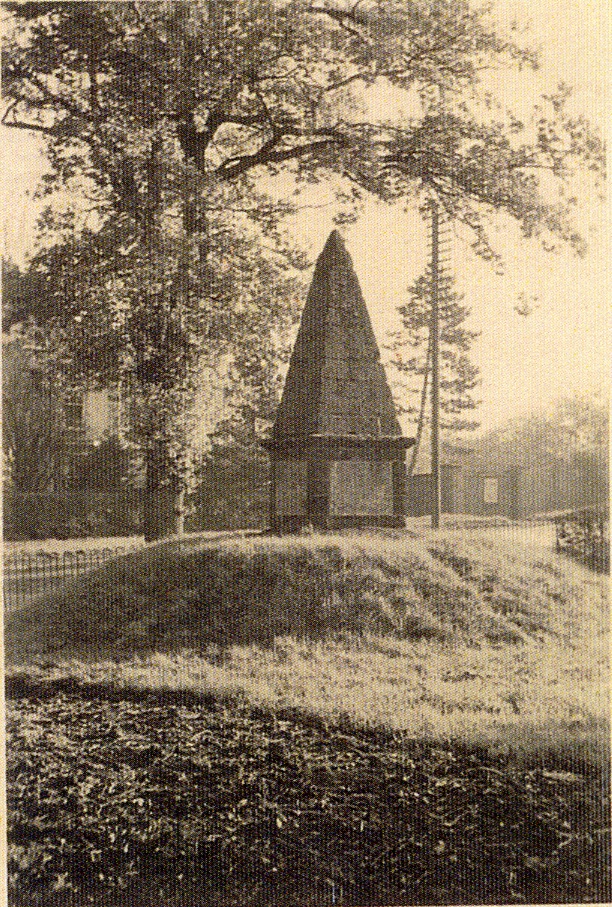
Growing up in Finedon during the 1950s, Obelisk was quite possibly the first foreign word I learned. As with most inquisitive little boys of that time I plagued my parents with questions about the real purpose of this, one of Finedon’s magnificent landmarks, the humble Obelisk. To fit in with the ‘boy’s own’ theme of those times I was told that the mound underneath the Obelisk itself was the burial place of the famous highwayman villain Dick Turpin’s horse Bess! Albeit being far from the truth, I have to admit I still have a soft spot for that harmless childhood untruth.
Situated where the A510 and the A6 cross, the Obelisk is still lightly veiled, to some degree, in mystery. It was made and erected by Sumpter of Irthlingborough c.1789 for Sir John English Dolben (c. 1750–1837) the 4th and final Baronet of Finedon (whose son, Colonel William Somerset Dolben had pre-deceased him).
Relatively short for an obelisk, it is made of coursed limestone and stands on a square plinth with plain cornice, there being a plain limestone tablet on each face. It could be reasonably assumed that each face may well have sported a distance marker, most likely to important places like Bedford, Leicester, Northampton and Peterborough, although these tablets are now so badly eroded it is impossible to prove this.
Distance marker or not, the other recognised reason for its existence is that of a celebration to commemorate the return to sanity of the King George III and to give blessings. Thanksgiving celebrations were held on 23rd of April, throughout the land, including at Finedon, where they were marked with fireworks displays and cannon fire!
The Obelisk serves Finedon well as a historical landmark of the area, reflecting the architectural styles of the late 18th century. While it may not be a widely recognised tourist attraction, it does hold local significance and adds to the historical landscape of Finedon.
 From Tingdene to Finedon