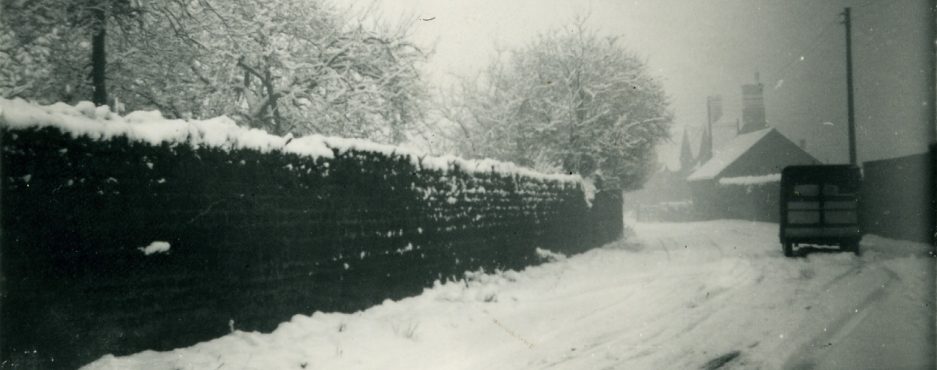
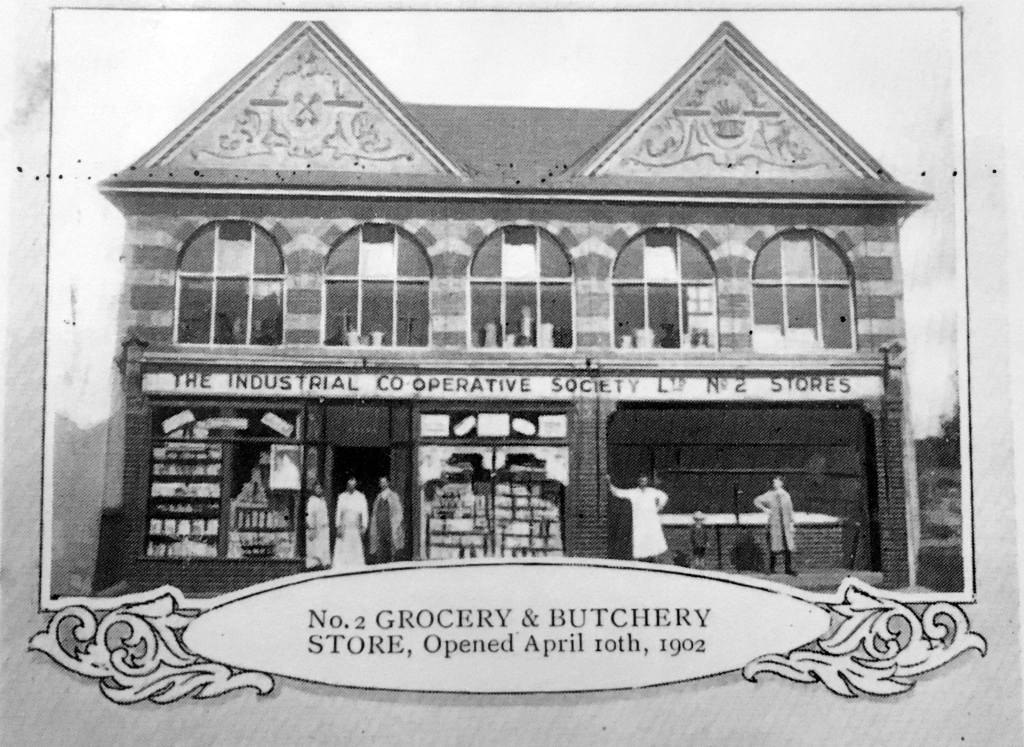
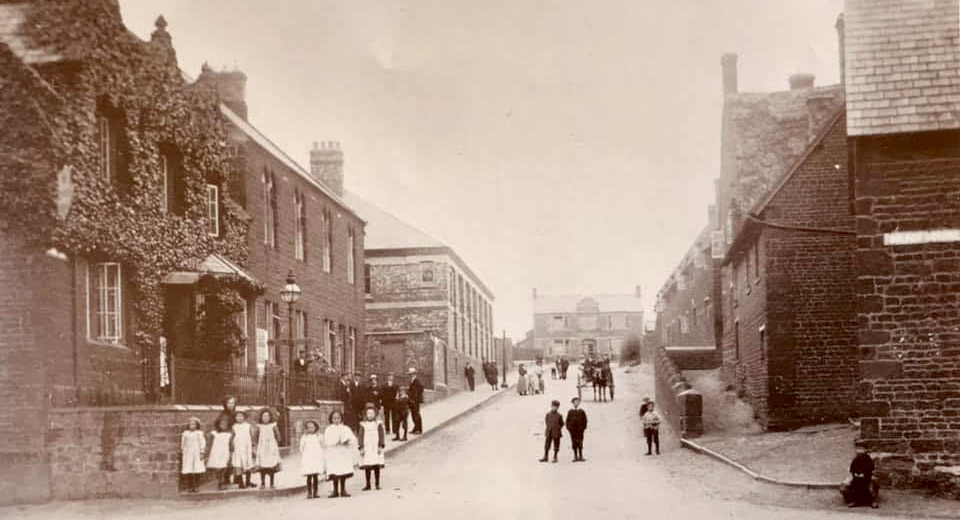
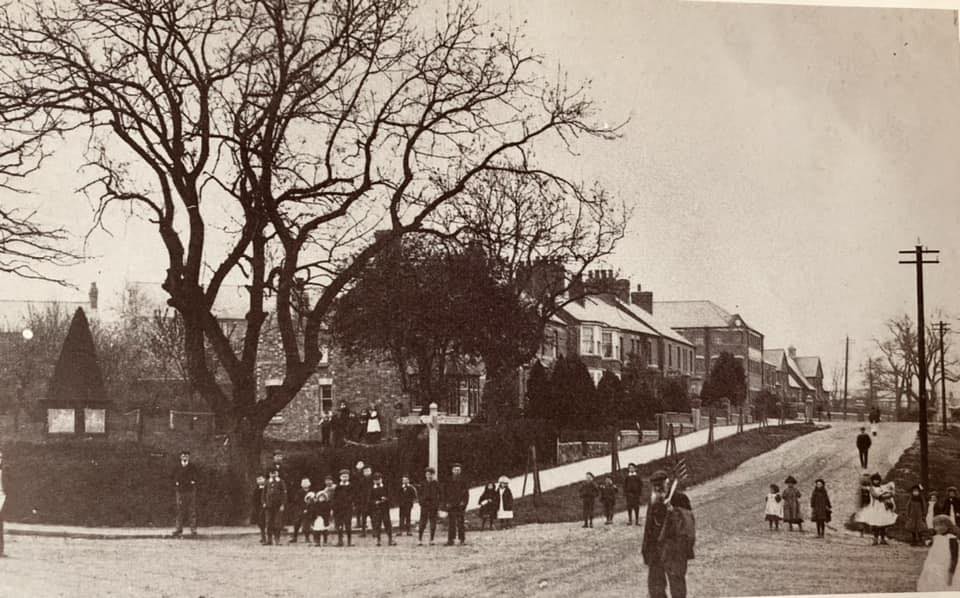
In the year 1900 the United Kingdom was in the Victorian era. However, within a year everything would change upon the death of queen Victoria which would usher in two new eras, The Edwardians and The Georgians.
The photographs reproduced below span the first six years of this new era, often now seen as an Indian Summer of untroubled times of great innovation and for some a growing prosperity.
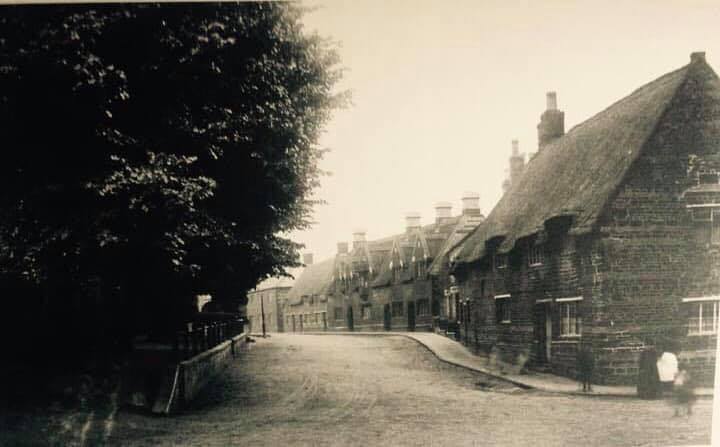
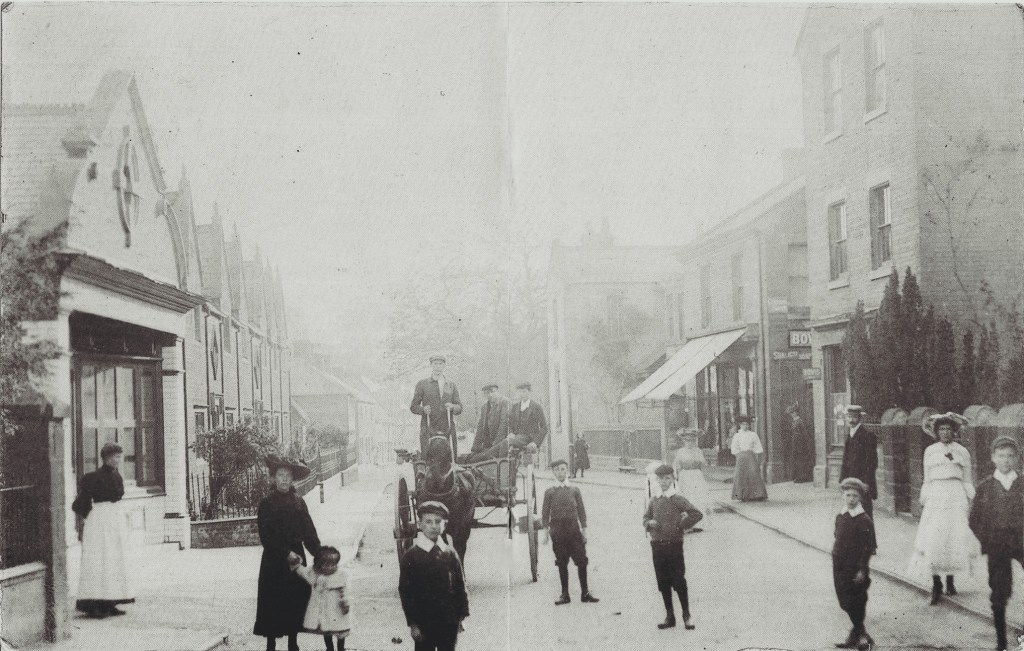
Below are Finedon Co-op 1902, Laws Lane 1903, Finedon Crossroads 1905, Lime Tree End 1903, Church St 1905, High St 1905 and an image of Finedon Parade 1905 in front of Bobby’s Entry Cottages.
The page image above is that of Hornsey’s Off License 1906
Finedon’s St Mary the Virgin Church is part of the Church of England, nowadays falling under the Diocese of Peterborough and within the Deanery of Higham, (a deanery helps in the coordination of pastoral care, common pastoral action, mutual support in the implementation of diocesan policies, the sharing of pastoral concerns, and facilitation of communication).
St Mary the Virgin is a Grade 1 listed building constructed of local ironstone and has a capacity for accommodating up to 350 parishoners. Constructed in what is termed ‘the decorated style’ it dates from circa the year 1350 and was originally owned by Croxton Abbey in Leicestershire. Its size is unusually large, being a parish church of such a small village (of no more than a few hundred inhabitants) as Finedon would have been at the time it was built.
It is thought most likely that the present Church was constructed by the monks of Croxton Abbey and its extravagant size indicates the importance of Finedon at that time. It is interesting to note that in 1291, Finedon, Higham Ferrers and Raunds were the three wealthiest benefices in the county of Northamptonshire.
(There is however a feasible suggestion that an earlier Norman church existed on the siteas the discovery of a stone font dating back to circa 1100 was discovered. It may also be of Saxon origin as Finedon was indeed an important Saxon meeting place).
St Mary’s is full of character with an impressive strainer arch, installed in the 14th or 15th century. The strainer arch was built across the nave to resist inward lateral pressure from the arches in the aisle. Other features have similarly impressive dimensions. The chancel measures 51 ft. by 21 ft., the north and south transept chapels are 31 ft. by 16 ft. The four-bay clerestoried nave measures 80 ft. by 20 ft. 6 in. and the north and south aisles are about 14 ft. 6 in. wide. The south porch, and west tower are 14 ft. 10 in. by 13 ft. 6 in, all these measurements being internal.
The pipe organ which was originally built for St George’s Chapel, Windsor was installed in 1717.
Above the porch is a small room known as the ‘Monks Cell’ containing the parish archives, together with a theological library of approximately 900 books that were donated by Sir John English Dolben in 1788. Whilst he original stairway from the south aisle is blocked, access to the chamber is now by an external stair turret added in 1794.
A further external stair turret can be found on the north side of the church at the junction of the nave and chancel. This originally led to a rood loft and onto the roof. The church tower and spire were built about fifty years after the main church building. It contains a peal of eight bells, a full octave in the key of D. The oldest bell dates from 1639 and has the inscription: ‘AS IN ADAM ALL DIE, SO IN CHRIST SHALL ALL BE MADE ALIVE’
The original clock (dated 1733) struck only the time but had no dial and was replaced by the present clock mechanism in 1876. Overall, the tower and spire rise to 133 feet above the ground, the steeple being struck by lightning in 1897 requiring a rebuild.
The Dolben vault, constructed to house the remains of the Dolben family c1710 is situated at the east end beneath the high altar. The only entrance is from outside and access is via a ladder. It is protected by iron railings and locked gates.
Although there are a few surviving medieval pews at the rear of the nave the rest were installed in 1858 during a general restoration. The chancel screen also dates from this time, the original believing to have been destroyed by Cromwell’s men. It was during this restoration that the font (previously mentioned) was rescued from nearby field, where it had been used as a cattle trough. The carvings on the font had been severely damaged and subsequently surrounded by painted woodwork to cover the mutilation. For some reason it was removed in 1837 and a new font installed but 21 years later it was back in its original pride of place.
Throughout its history eight Rectors and fifty-three Vicars have served as incumbents. 2024 saw the town welcome its 54th incumbent Vicar to the parish. The longest serving incumbent was the Revd George Paul, who was installed in 1848 and loyally served the parish for over 60 years.
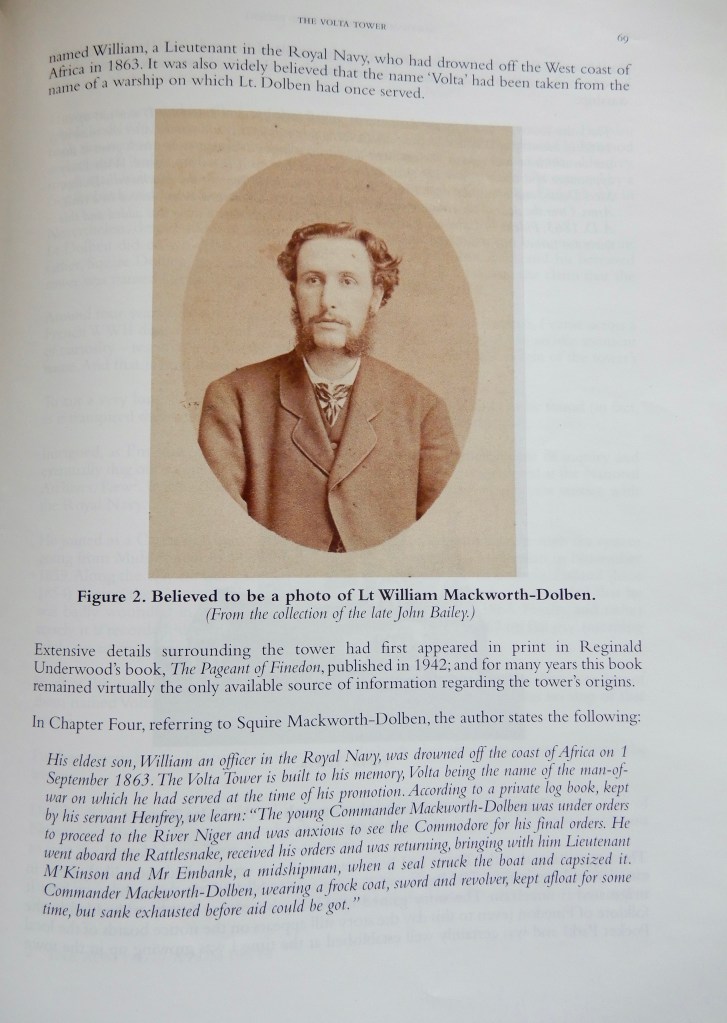
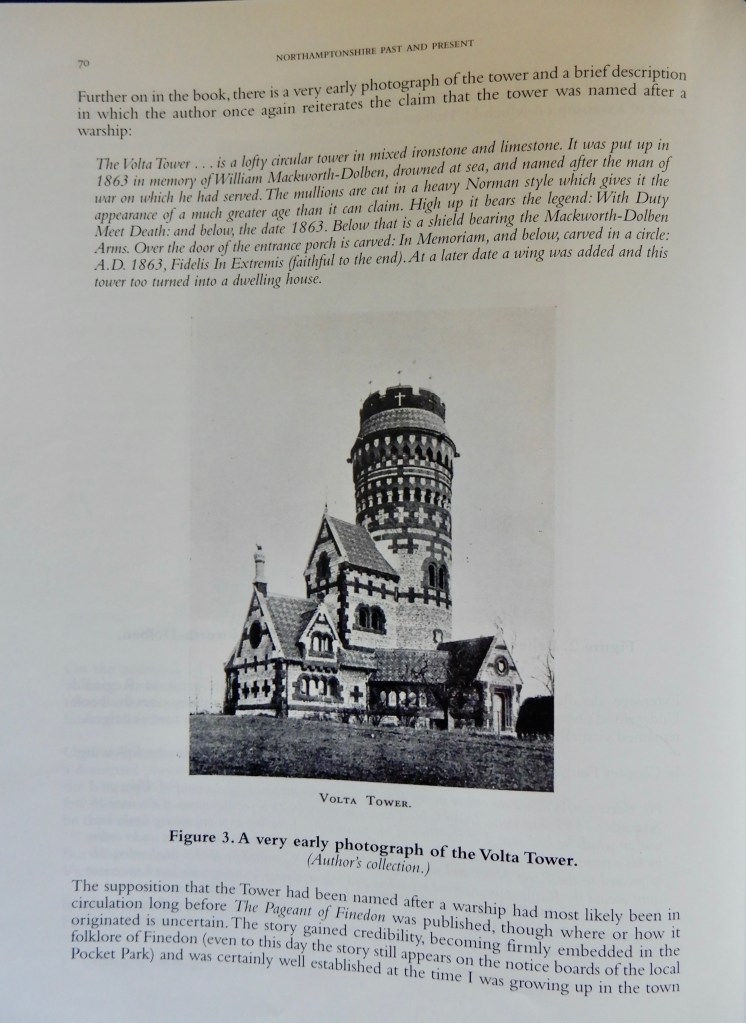
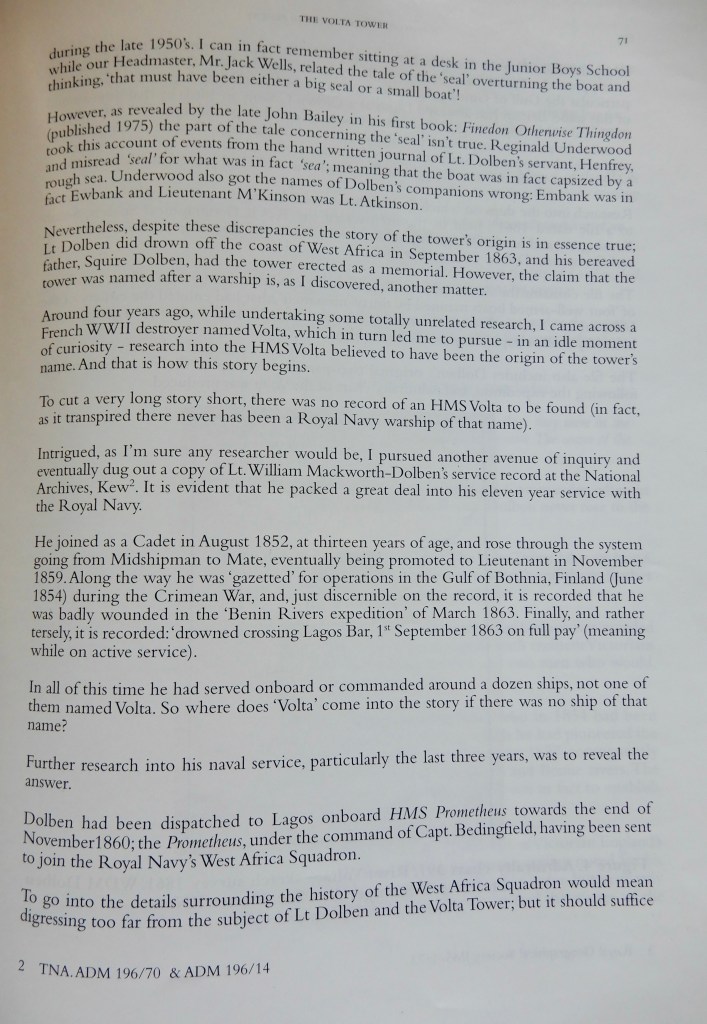
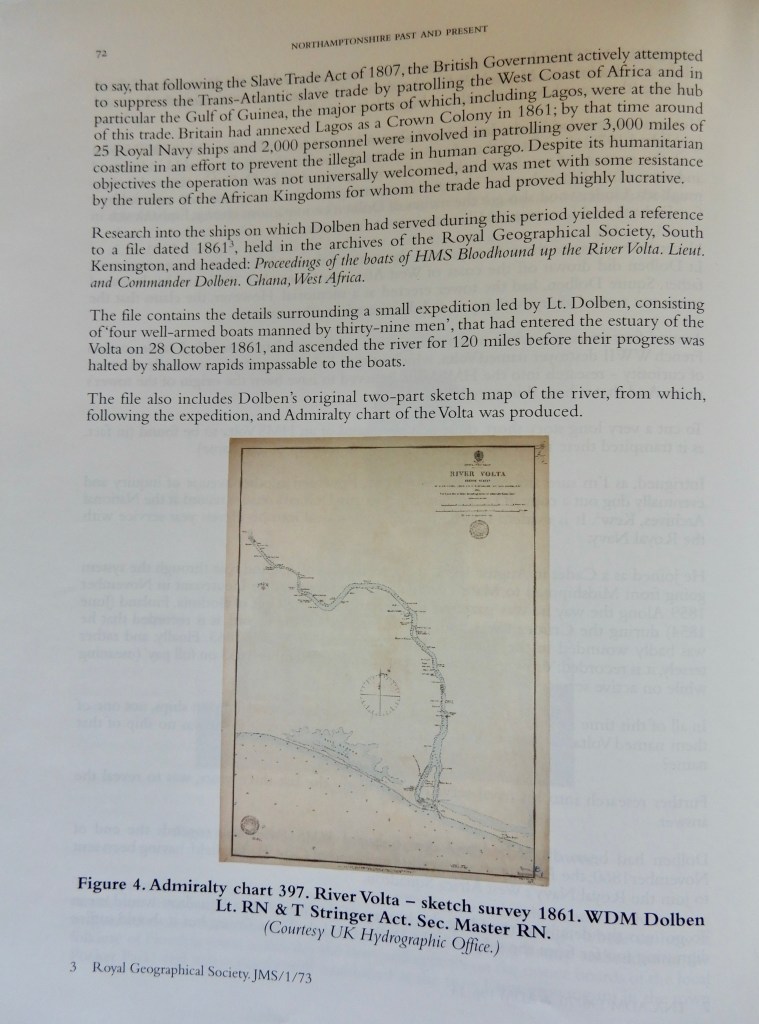
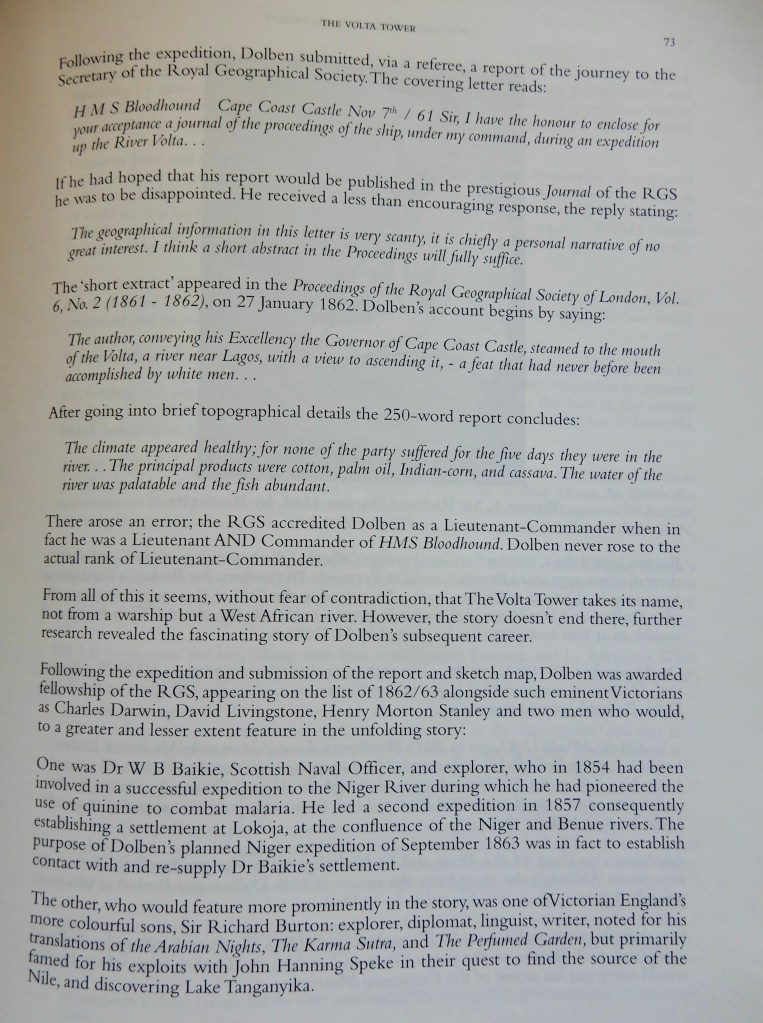
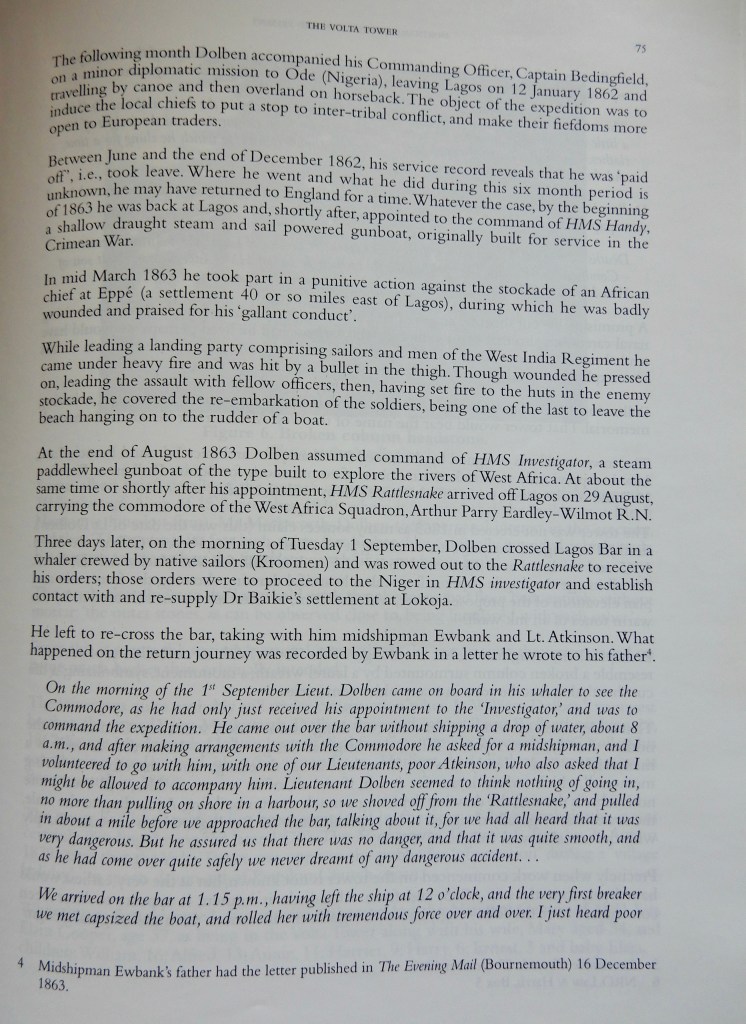
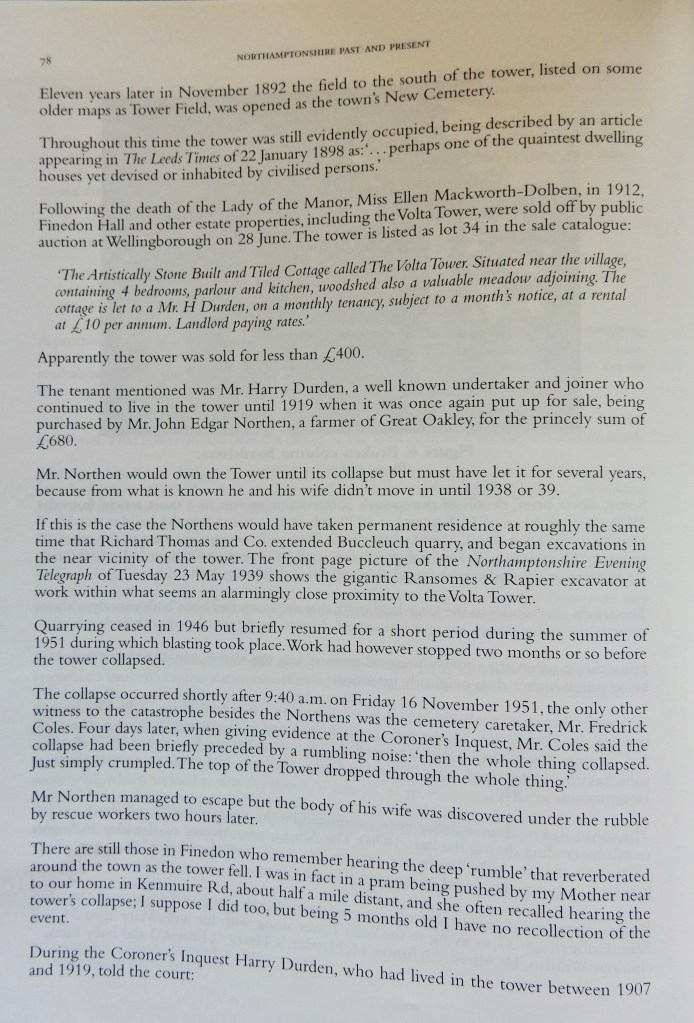
The Finedon Local History Society are delighted to have been given permission to reprint a comprehensive article written by Ron Clayton concerning the building of the Volta Tower and accompanying biography of Lt William Mackworth-Dolben.
This article originally featured in Northamptonshire Past and Present No 71 in 2018 associated with the Northamptonshire Record Society. The article has been reproduced by photographing the original and therefore some pages may appear to be out of alignment.
On behalf of the Finedon Local History Society, I would like to wish all ‘Finedonians’ a very Merry Christmas and a Happy and Prosperous New Year in 2025
It has been said, that at one time it was possible to note where a local hailed from (be that Irthlingborough, Burton Latimer or Finedon) from by listening to the particular terms and expressions he/she used whilst conversing, usually whilst out and about in the street.
In order to preserve and make some sort of list of these wonderful terms we list here some of those donated by current residents, I am sure that many more will come to light in due course and will of course be added to this Finedon dictionary of sorts.
They are listed in alphabetical order with some liberties taken where necessary.
‘Air and ‘Ere(as in ‘air dad or ‘ere mum, used instead of our).
~
‘Apenny on Himself/Herself’(someone who thinks they’re better than someone else, a show-off).
~
Benefit(as in take your coat off indoors or you won’t feel the benefit when you go outside).
~
Black over Bill’s Mothers(denoting poor weather on the way).
~
Bottom End or Top End (relating to the old part of Finedon close to the church, and the newer parts built after the war).
~
Chelp(backchat or complaining verbally as ‘stop yer chelping’).
~
Chopsin(talking, gassing or gossiping ie, using one’s mouth or ‘chops’).
~
Doolalee(one of many localisms for acting daft or silly, of Indian origin brought back by returning army troops).
~
Down Street(going out to local shops, no actual destination mentioned).
~
Dunky’s Years(a considerable length of time).
~
Ent Kent Shent Wunt and Ennagunoo(brilliant vernacular saying for a refusal to do something replacing the words isn’t, can’t, won’t and aren’t going to).
~
Fur Coat no Knickers(can be used in a variety of ways often meaning, not all it appears to be or someone overdressed or acting above themselves).
~
Frit(to be frightened).
~
Gawping(having a ‘nose’ at something/someone or taking a very long look).
~
Gone for a Burton (as in to denote something or someone has come to grief or crashed etc).
~
Mardy Arse(having a strop or being overly cantankerous).
~
Mullocks or Mullocky(a somewhat unsavoury state of affairs or dirty/untidy conditions).
~
Old Boy(used to denote youth not old age, as in our young old boy),
~
Peps(sweets often those sold loose in the old days, as in a quarter of peps).
~
Shallata goo me duc(I will have to go now or I’ll be late).
~
Skek ‘um up(as heard during a raffle, as in shake the bag of tickets up).
~
Skewwiff (something or a piece of clothing not on straight or lying right).
~
Spruce(any flavoured soft drink as in a bottle of Spruce).
~
Tar(a colloquial thank you).
~
The Glue Blot(colloquial reference to the Conservative Club).
~
Tied up ugly(usually used to denote a scruffy or dishevelled person or thing, as in a sack of ‘cack’ tied up ugly).
~
Here are some composite phrases
‘shent tek me coat off I ent goin fur’.
‘there cat run up ‘er entry’.
‘carry on bawling and oyl giv ya somat to bawl about’.
‘yer neither use nor ornament’.
‘d’year? leave me dug ubee’.
‘eat yer buppy an dawnt roar’.
‘gooin air gate for a holiday’.
‘gooin up the wooden Hill to Bedfordshire’.
‘gunna t’ek the dug for a walk’.
‘tizz en it’.
‘sonsin about like a kelly on a string’.
‘anybody’d think you’d got St Vitis Dance boy’.
‘use yer nassum boy’.
‘nip round Swannies and get me twenty fags and pay the papers’.
‘for Christ sake, act sharp’
‘What yer got there, a bag o’ mullocks’.
‘kent stop gassing, I’ve got summat on the stove’.
‘don’t be an ugg’.
‘gooing down the garden field’
‘wer you ent arf sharp’.
‘it dorn’t do to say too much’
‘kent wunder ad’it this bloody weather
‘om frit te death ov ‘im and ‘er.
‘dorn’t thro that away, I’ll av the noggy’.
‘I’ll goo to the foot of ‘ere stairs’.
“dunt matta what they call y me duck, as lung as they dunt call y too late fur yur dinna!”
Digby Augustus Stewart Mackworth Dolben was born on 8th February 1848 on the island of Guernsey but spend most of his short but formative years at Finedon Hall.
He was the son of William Harcourt Isham Mackworth, 1806-1872, himself the younger son of Sir Digby Mackworth, (the third baronet) who added the additional surname Dolben following his marriage to Frances, heiress of Sir John English Dolben.
Digby was educated firstly at Cheam School and subsequently at Eton College under the influential Master William Johnson Cory. Cory both inspired and nurtured Digby’s poetic aspirations by having produced a collection of poems himself entitled ‘Ionica’.
Perhaps a more significant source of inspiration was derived from that of his cousin Robert Bridges, who would later hold the prestigious accolade of Poet Laureate from 1913 to 1930. Being older than Digby, Bridges took him under his personal tutelage so to speak.
A Song
The world is young today:
Forget the gods are old,
Forget the years of gold
When all the months were May.
A little flower of Love
Is ours, without a root,
Without the end of fruit,
Yet ― take the scent thereof.
There may be hope above,
There may be rest beneath;
We see them not, but Death
Is palpable ― and Love.
Digby’s behaviour during his early schooldays and adolescence was both controversial and to some degree rather scandalous. He developed a romantic attachment to another older boy, Martin Le Marchant Gosselin and wrote several love poems to him. He also began to follow the doctrine of an English theologian, Dr E B Pusey, who advocated the revival of the Catholic doctrine in the Church of England. This being totally opposite to Digby’s staunchly Protestant upbringing.
However, perhaps Digby’s most outrageous affectation was his assumed allegiance to the Order of St Benedict and a considered conversion to Roman Catholicism which occasionally entailed him wearing a monk’s habit, going barefoot and calling himself Brother Dominic, which obviously caused much embarrassment to his family.
Sadly, around this time, 1863, Digby, in an unfathomable fit of pique, destroyed all his poems by burning them, in what Robert Bridges called a “holocaust.”
Poppies
Lilies, lilies not for me,
Flowers of the pure and saintly―
I have seen in holy places
Where the incense rises faintly,
And the priest the chalice raises,
Lilies in the altar vases,
Not for me.
Leave untouched each garden tree,
Kings and queens of flower-land.
When the summer evening closes,
Lovers may-be hand in hand
There will seek for crimson roses,
There will bind their wreaths and posies
Merrily.
From the corn-fields where we met
Pluck me poppies white and red;
Bind them round my weary brain,
Strew them on my narrow bed,
Numbing all the ache and pain.―
I shall sleep nor wake again,
But forget.
It was on his seventeenth birthday in 1865 that Digby Dolben’s poetic journey reached an important milestone. Robert Bridges introduced Digby to Gerard Manley Hopkins, nowadays considered to be one of England’s greatest poets of the Victorian era. In the words of Hopkins’s biographer Robert Bernard Martin, Hopkins’s meeting with Digby Dolben, “was, quite simply, the most momentous emotional event of his undergraduate years, probably of his entire life”.
Hopkins was completely taken with Digby, who was nearly four years younger than he, using his private confession journal to illustrate his suppressed erotic thoughts of him.
He maintained a correspondence with Digby, writing about him in his diary, also composing two poems about him, “Where art thou friend” and “The Beginning of the End.”
Two years later on May 2nd 1867, Digby Dolben fainted during his Oxford University entrance exams thus, failing them. In order to re-attempt qualification he travelled to meet a new tutor. Digby Dolben tragically drowned on the 28th June 1867 in the River Welland whilst bathing with the ten-year-old son of his new tutor, Rev. C. E. Prichard, the Rector of South Luffenham in Rutland. Digby was then aged only 19 and never completed his preparations to go up to Oxford University.
Enough
When all my words were said,
When all my songs were sung,
I thought to pass among
The unforgotten dead,
A Queen of ruth to reign
With her, who gathereth tears
From all the lands and years,
The Lesbian maid of pain;
That lovers, when they wove
The double myrtle-wreath,
Should sigh with mingled breath
Beneath the wings of Love:
‘How piteous were her wrongs,
Her words were falling dew,
All pleasant verse she knew,
But not the Song of songs.’
Yet now, O Love, that you
Have kissed my forehead, I
Have sung indeed, can die,
And be forgotten too.
Robert Bridges guaranteed Digby Dolben’s reputation by publishing a book simply called Poems by Digby Mackworth Dolben (1911) all of which must have been written in only a three-year period following the burning of his previous collection and with his inclusion in the publication of Three Friends: Memoirs of Digby Mackworth Dolben, Richard Watson Dixon, Henry Bradley (1932). Subsequently, a publication titled The Poems and Letters of Digby Mackworth Dolben 1848–1867 was produced in 1981
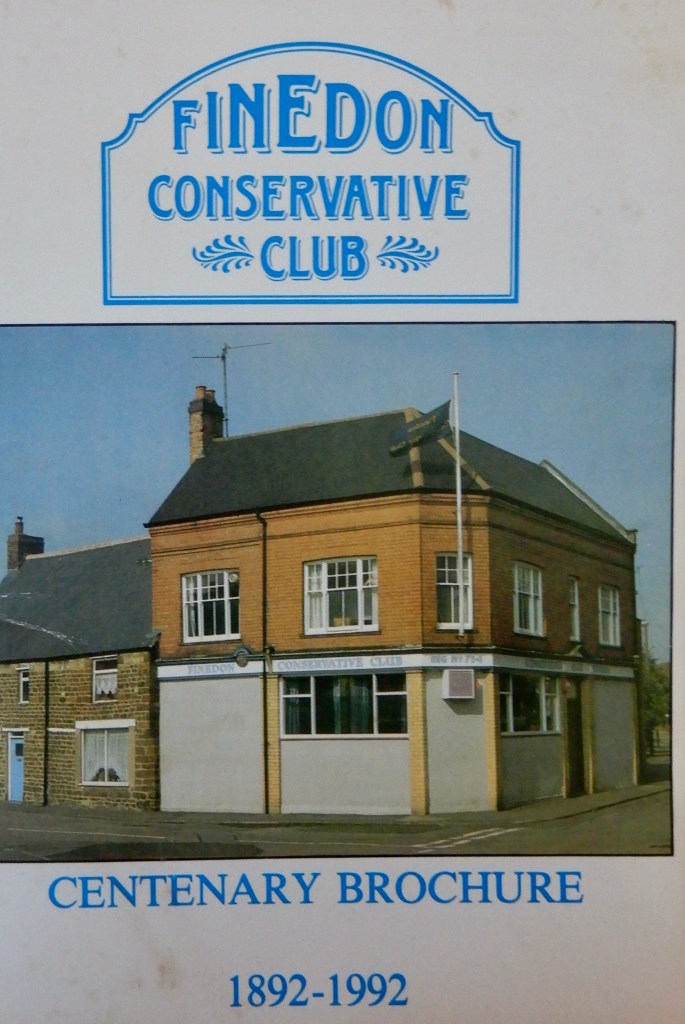
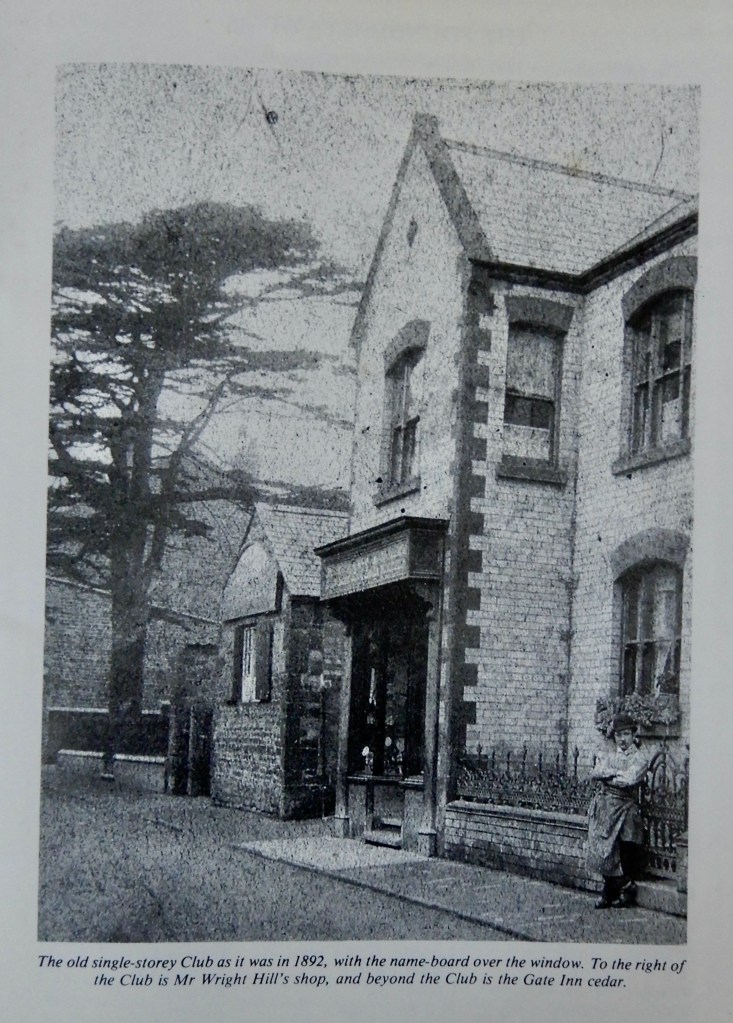
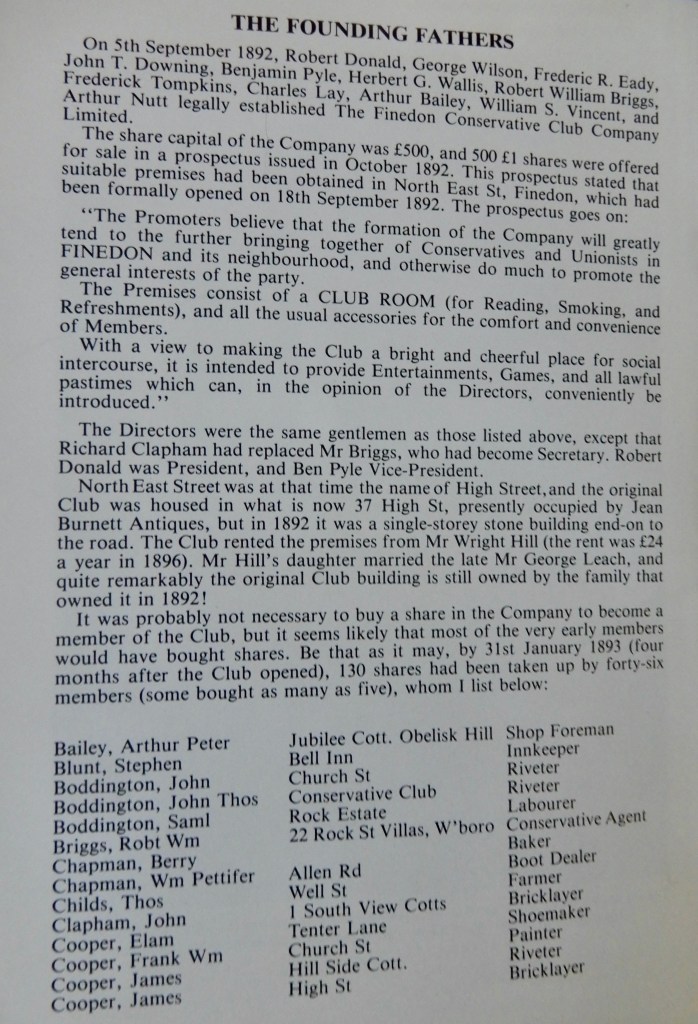
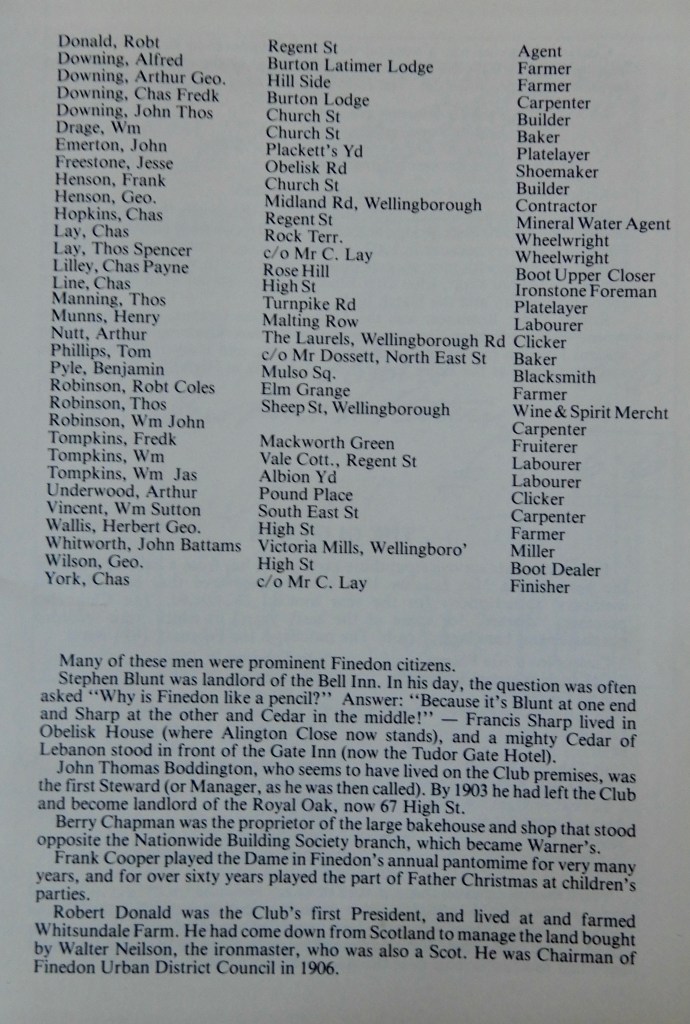
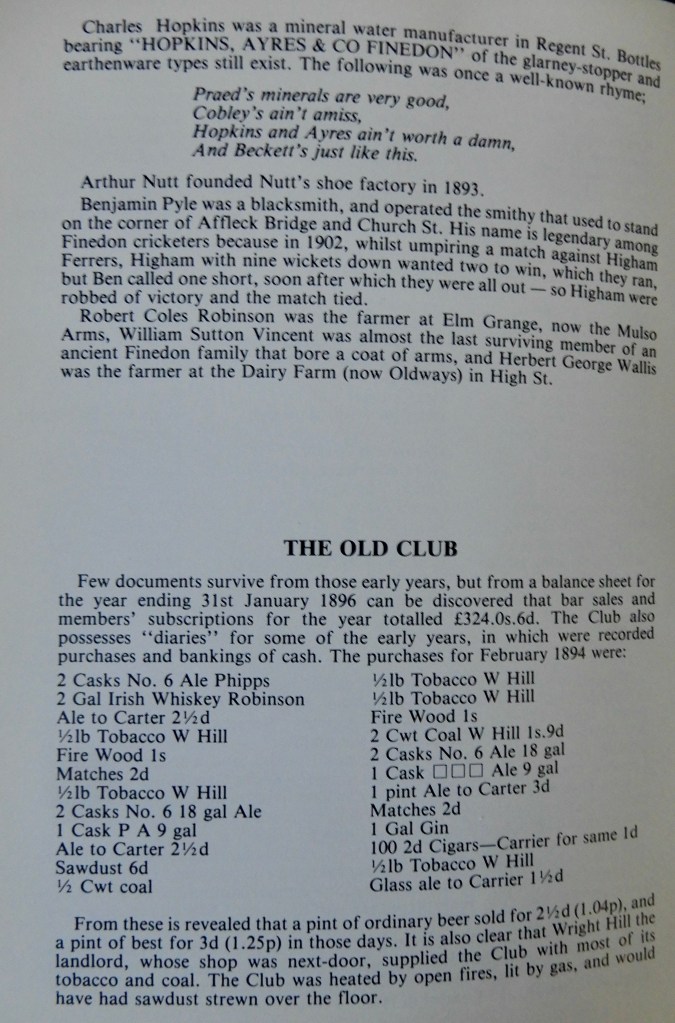
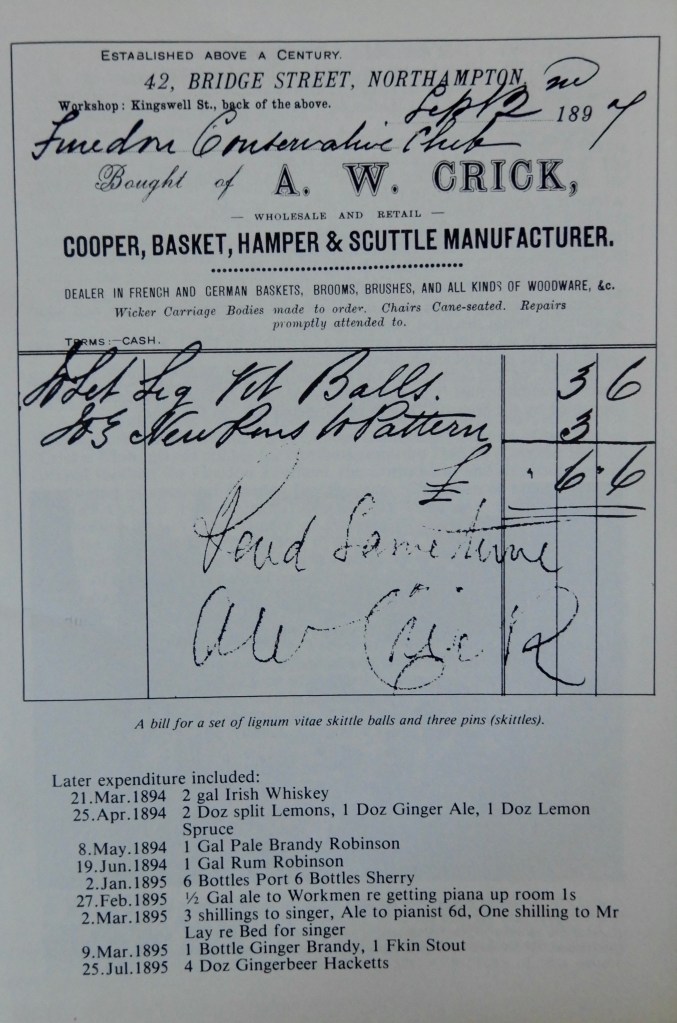
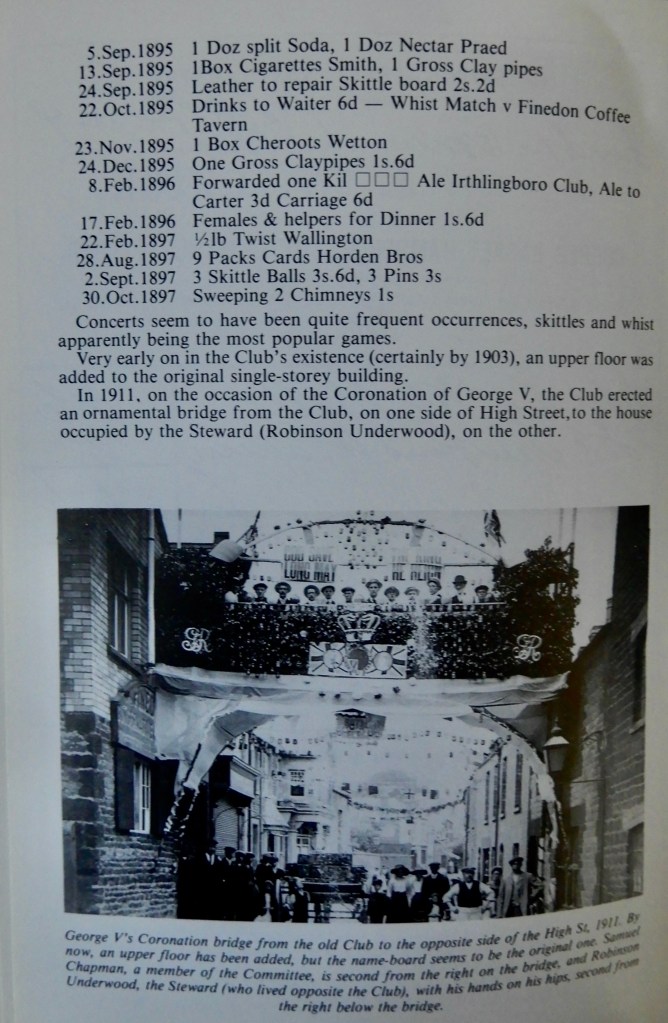
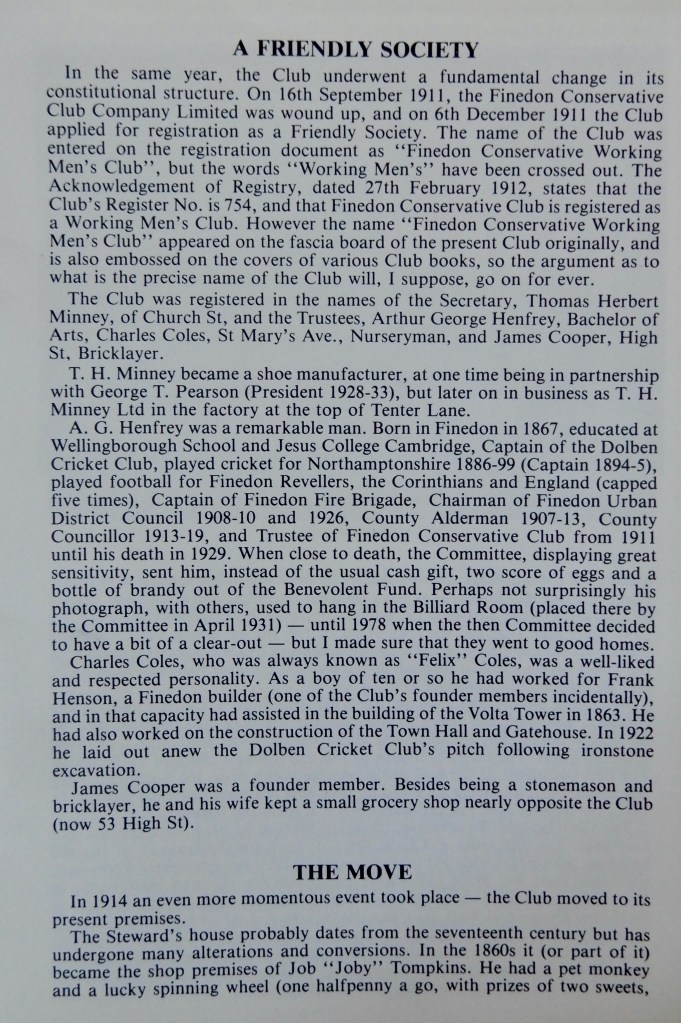
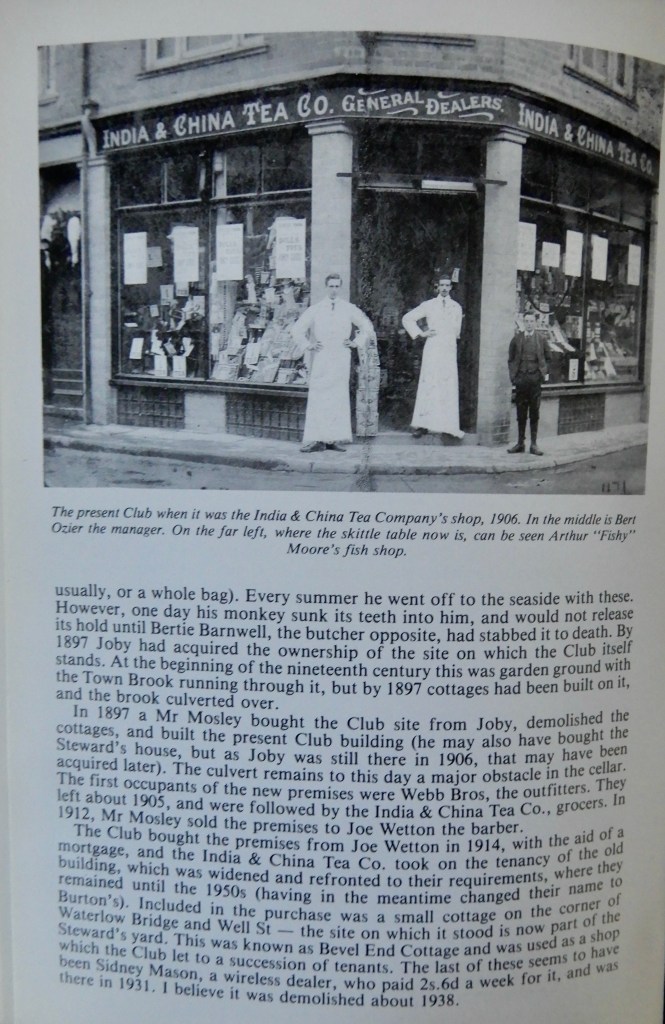
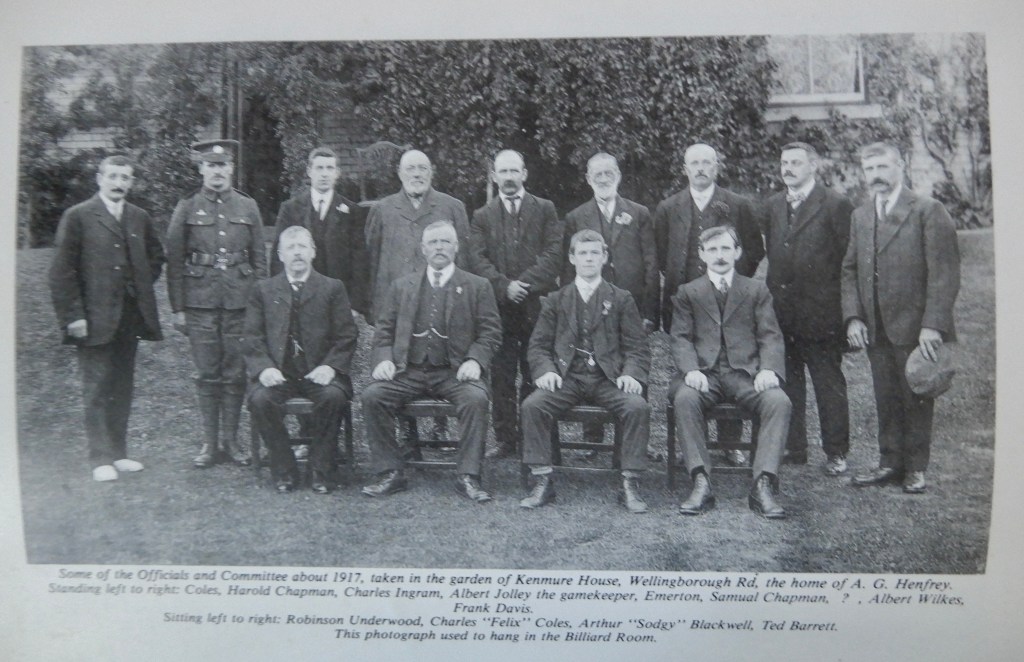
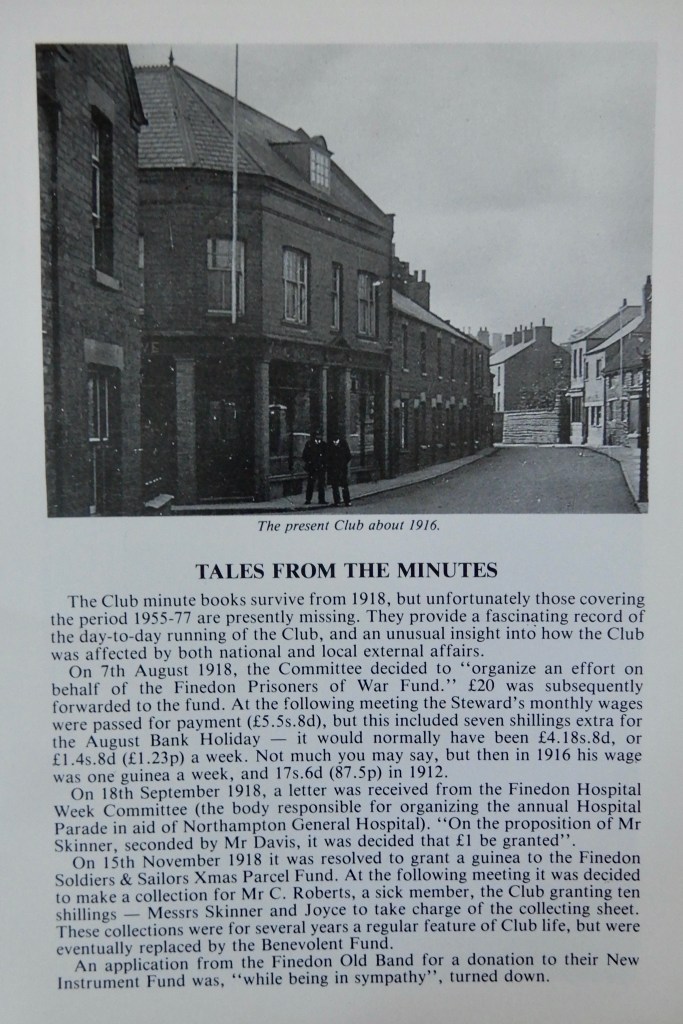
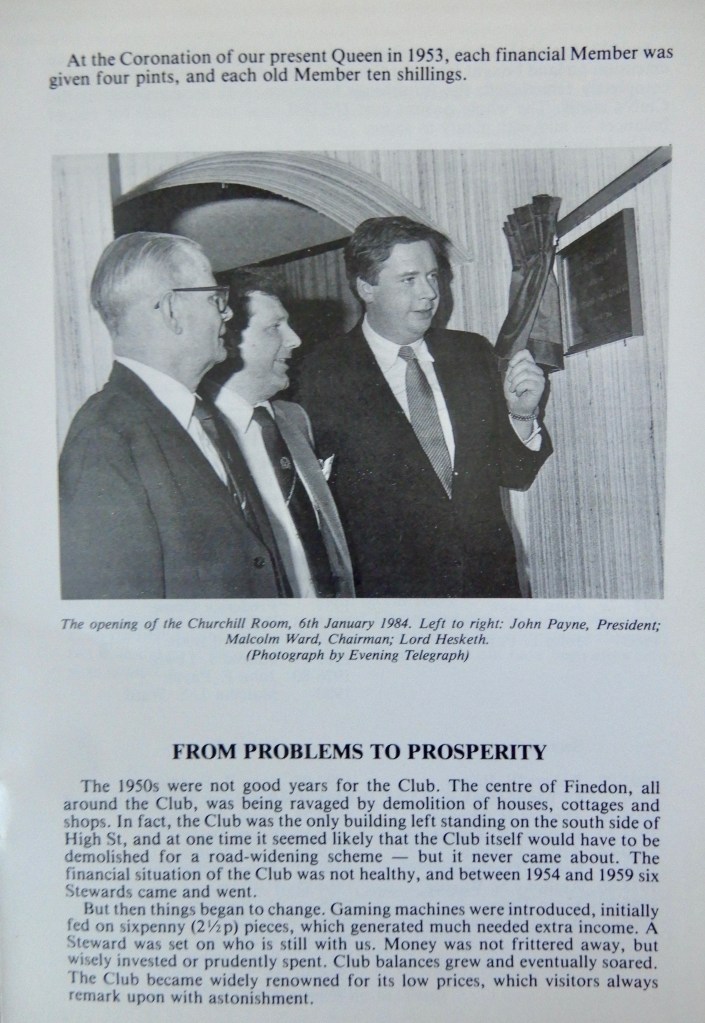
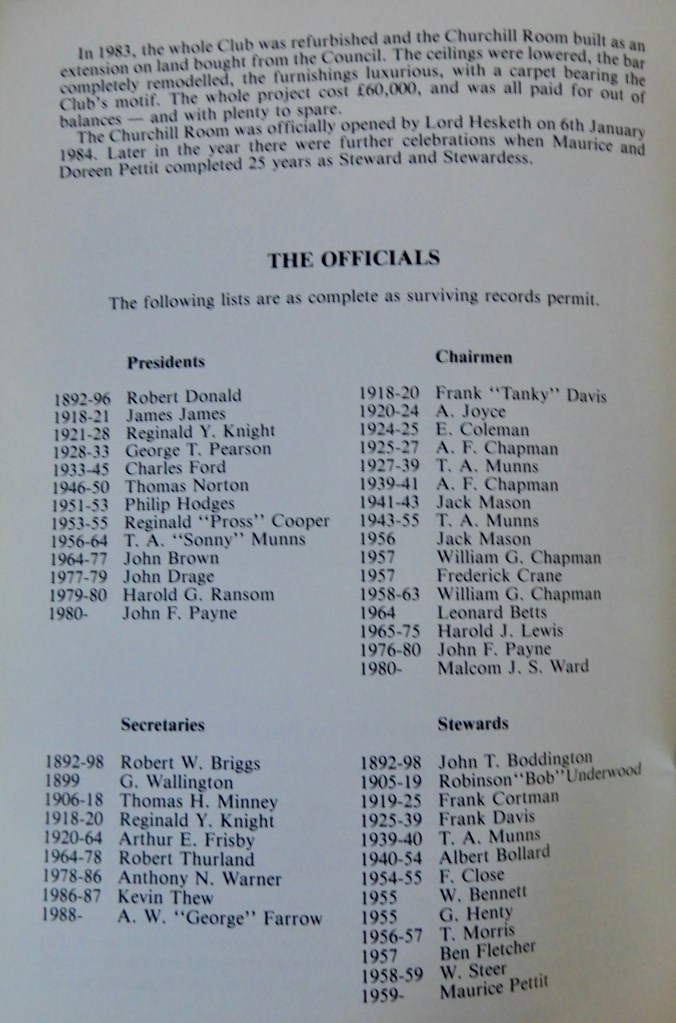
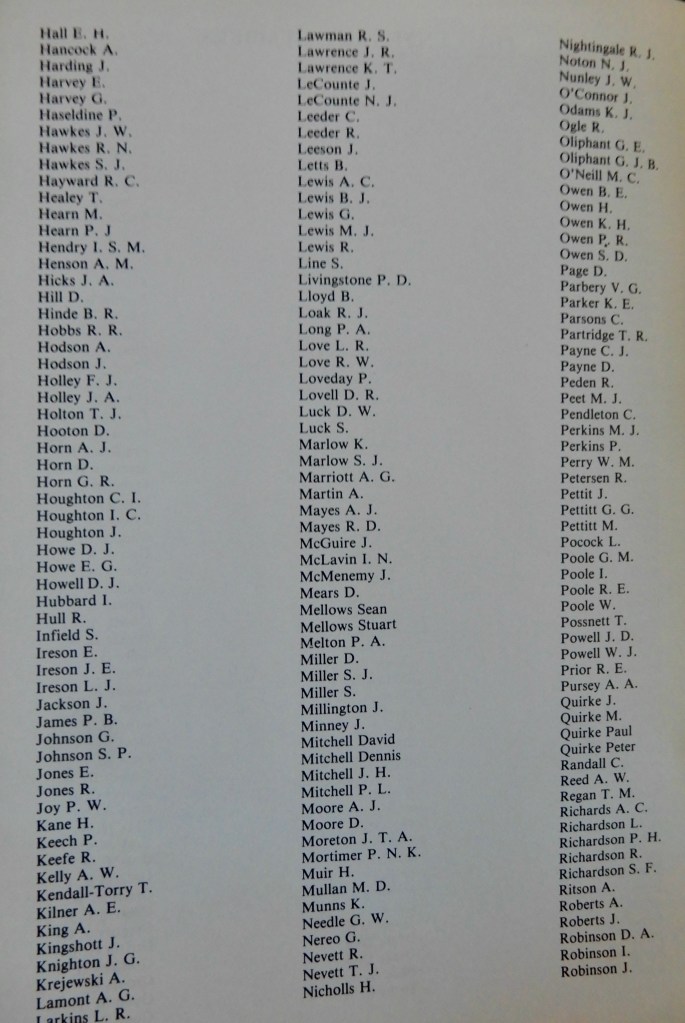
In 1992 Finedon’s Conservative Club celebrated its centenary. The commemorative brochure reproduced below is a wonderful treatise to the history of the organisation.
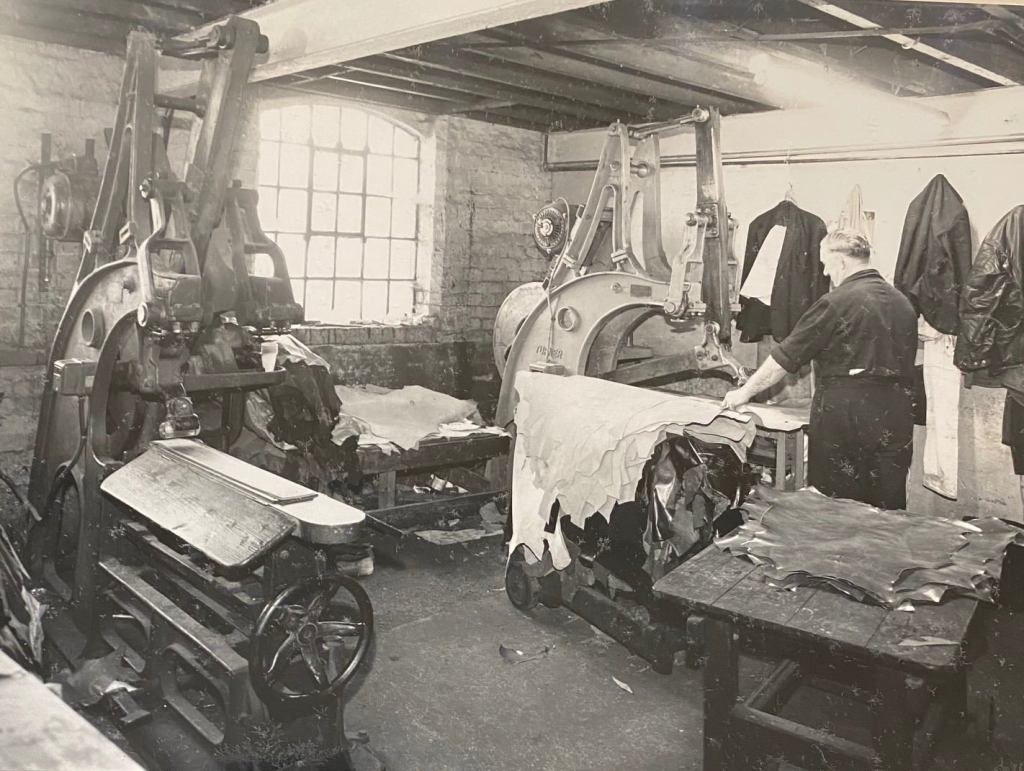
From the middle to late 19th century until the 1970s shoemaking was the major source of employment for many communities in Northamptonshire, Finedon was no exception. At its peak in the 1950s there were nine significant boot and shoe factories in the town, together with other businesses supplying materials and components.
Prior to the middle of the 19th century footwear was made by ‘cordwainers’ who made shoes by hand for local people. Often the parts of the ‘uppers’ were sown together (known as closing) by the shoemaker’s wife. All this changed as mechanisation was eventually developed.
Initially, treadle sewing machines were introduced to sew the uppers and small groups of people joined together in homes and barns, known as Outworkers to produce uppers and other components for a shoemaker. Later, larger, more powerful machines which could stitch the uppers to the soles of the shoes were introduced. These could only be economically used in factories built especially for that purpose.
~
1886
The Finedon Co-operative Society Boot and Shoe Company was founded at the junction of Obelisk Road and Mulso Road. This factory closed in 1935 and was taken over by the Debdale Leather Company.
1889
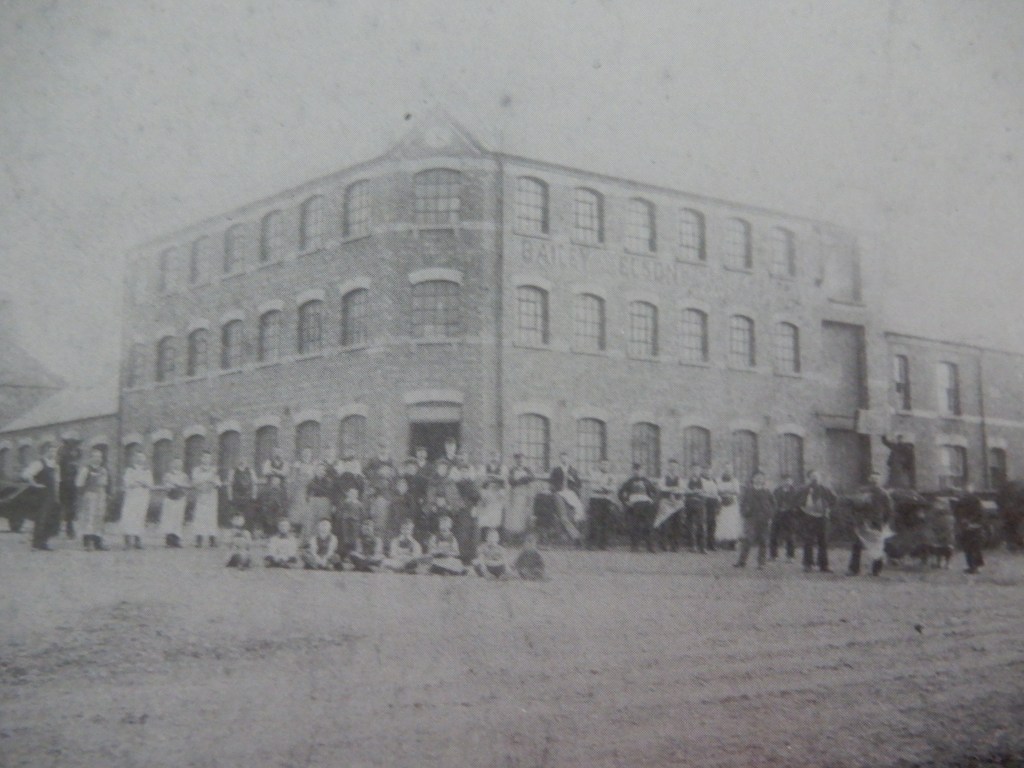
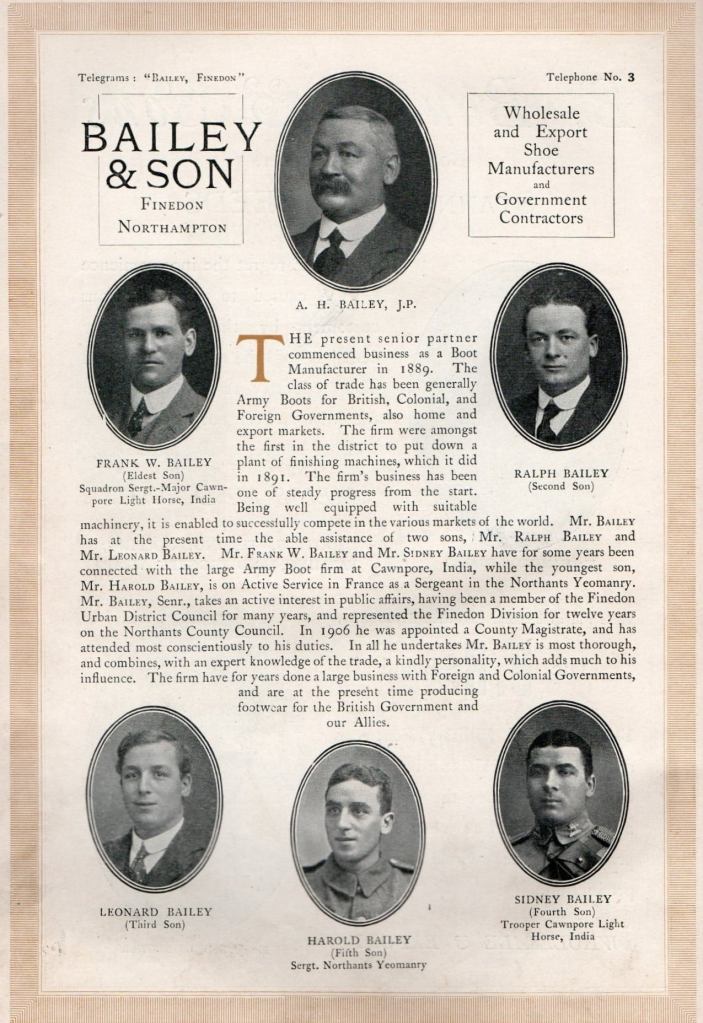
Albert Bailey and Samuel Elson started the firm of Bailey and Elson which was situated on the corner of Mulso Road and Wellingborough Road. Albert Bailey has previously worked at Charles Wright’s factory in Church Street. The partnership was dissolved in 1900 and became known as A.H. Bailey and Sons, in which at various times the father worked with up to five of his sons. This factory was closed and demolished in the 1960s.
~
Bailey and Elson 1897
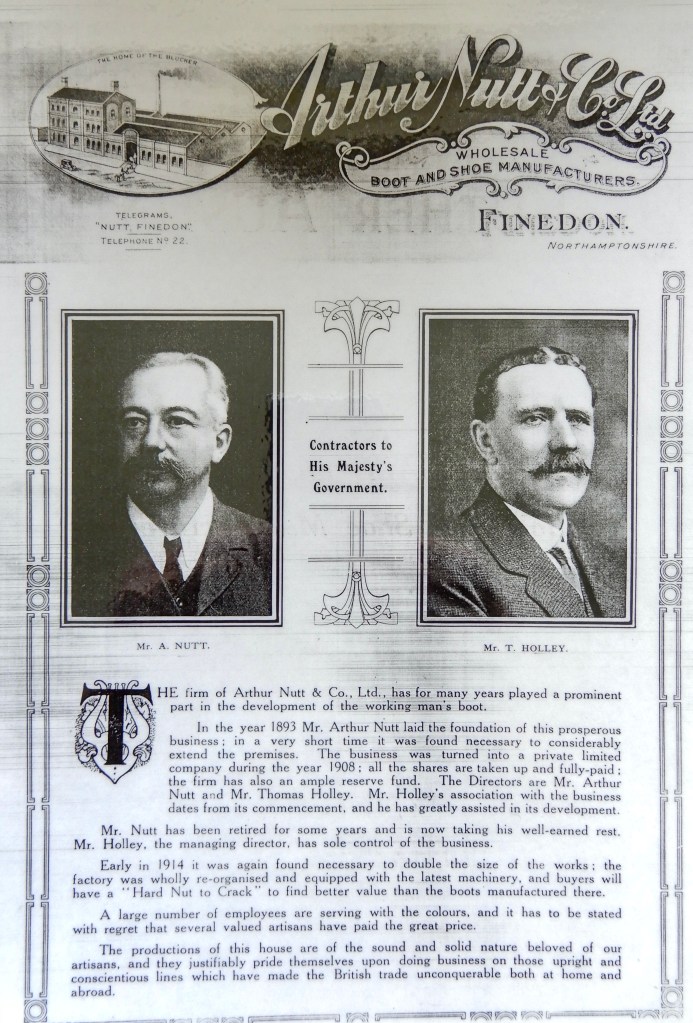
In 1893, Arthur Nutt founded his company in Wellingborough Road which was eventually taken over by the Coles Group before becoming part of the Griggs Organisation, which produced the ‘Doc Martin’ range of footwear. The factory closed in the 1990s and has since been converted to flats as is Minney’s factory.
~
1900
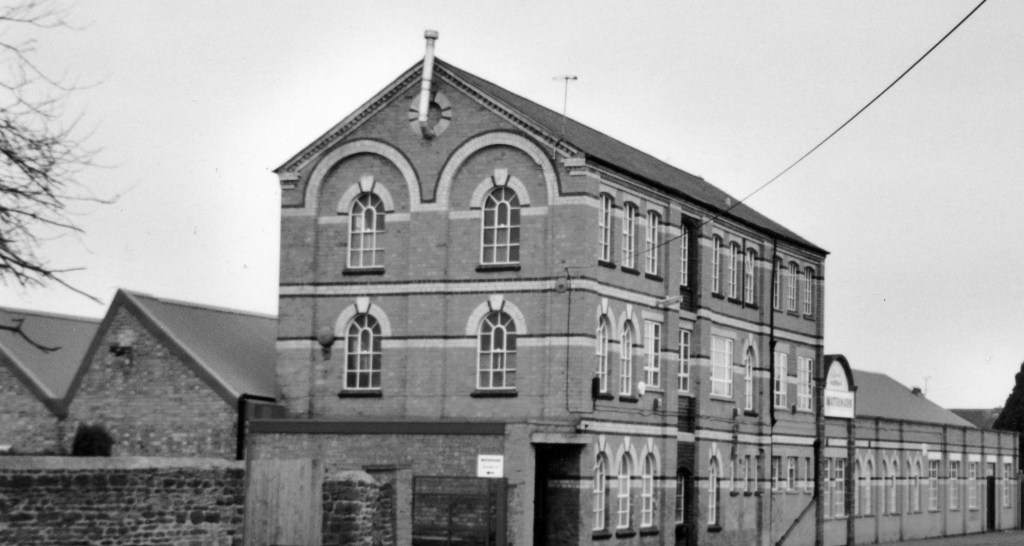
Having split with Albert Bailey, Samuel Elson went on to build the Tower Boot Company situated between Wellingborough Road and Well Street. Sadly, the firm went bankrupt in 1904 and Elson emigrated to Canada with sixteen members of his family. The factory was later owned by the Pearson family for a considerable time before it became part of the Griggs Organisation and later closed.
In 1910, the firm of Yorke Brothers was started in Finedon by R E and W A Yorke. W A died in 1915 but the firm carried on producing boots for the army during the Great War as did many others. Exactly where the factory was is not clear but was it the same Yorke Brothers who traded in Wellingborough for many years.
In 1929, the firm of John R Gammidge was started, situated between Summerlee Road and Milner Road. It was created by John Gammidge and Alfred Minney. Subsequently their sons Peter Gammidge and John Minney took over the business. In 1995, the firm closed the Finedon factory and moved to Kettering Parkway, where they designed and marketed footwear as opposed to manufacturing them.
~
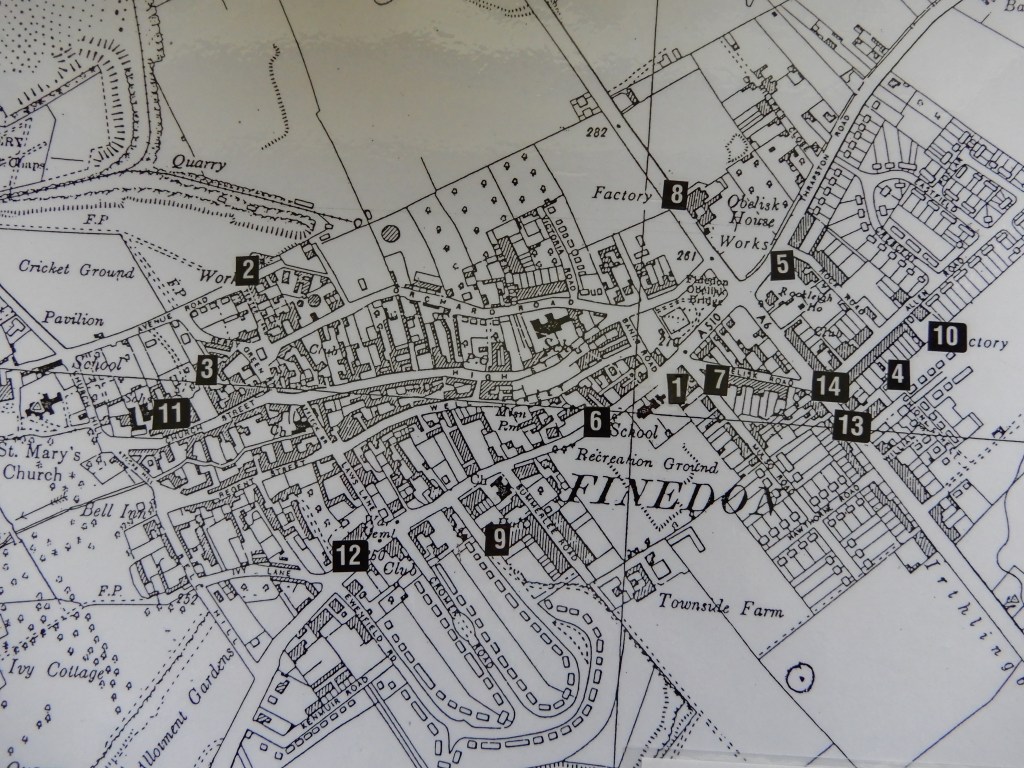
Locations of Finedon’s Boot and Shoe Factories
1. A.H. Bailey & Son,
on the corner of Obelisk Rd and Wellingborough Rd
2. A.W. Minney & Sons
(Tower Works), at the top of Tenter Lane
3. Roy Bailey,
Situated at Berry Green
4. Coggins,
In Allen Rd a small ‘Closing Room’ operated by Coggins of Raunds.
5. G. Knight,
at the corner of Rock Rd and Thrapston Rd, later to become Rockleigh
Shoe Company (Loakes Bros).
6. The Tower Boot Company,
Situated between Wellingborough Rd and Well St.
7. Finedon Co-operative Boot and Shoe Company,
located at the junction of Obelisk Rd and Mulso Rd
8. J.T. Hawthorne
Located on Burton Rd, later to become Rockleigh Shoe Company
(Loakes Bros) Closing Room.
9. J. R. Gammidge Ltd,
Spanned between Summerlee Rd and Milner Rd.
10. Trolley Brothers,
Situated along Allen Rd.
11. Charles Wright,
Located at the bottom end of Church St.
12. Arthur Nutt and Co Ltd,
On the corner of Wellingborough Rd and Laws Lane, later to become Coles’s Tower Boot and R Griggs & Son.
13. J.H.Fox,
Situated on Irthlingborough Rd, later to become Highfield Boot and Shoe, sadly destroyed by fire in 1926.
14. Arthur Parker/Elam Cooper,
Located on the corner of Irthlingborough Rd and Allen Rd.